philosophy

Broken Baby Jesus

by Howard Hain

(Note: This post was originally published on December 24, 2011.)
broken-baby-christ-2


We have not put up a tree in years.

For nearly a decade we have been moving—no longer than two years in any one house and no less than ten different not-so-humble abodes. Between and during the moves we were very much engaged with the world. A seemingly endless movable beast.

This December marks one year in our current house. I am happy to say it is our home. The Lord has blessed us with great peace. And with that peace comes a tree. A simple, well-shaped tree. Fittingly, a dear friend offered it to us as a gift.

Francesca could not be more ready to be initiated into the act of trimming. Before the tree arrived, her two-year-old fingers pointed out every tree, artificial or real, that graced the pages of a holiday flyer or the commercial floor of a Rite Aid or Dollar Store.

Up the stairs came the evergreen, into the old stand that has been in storage since my father last used it several decades ago. I cut off the mesh and out popped the branches.

We hung the lights and old glass ornaments that my mother-in-law washed a few days before.

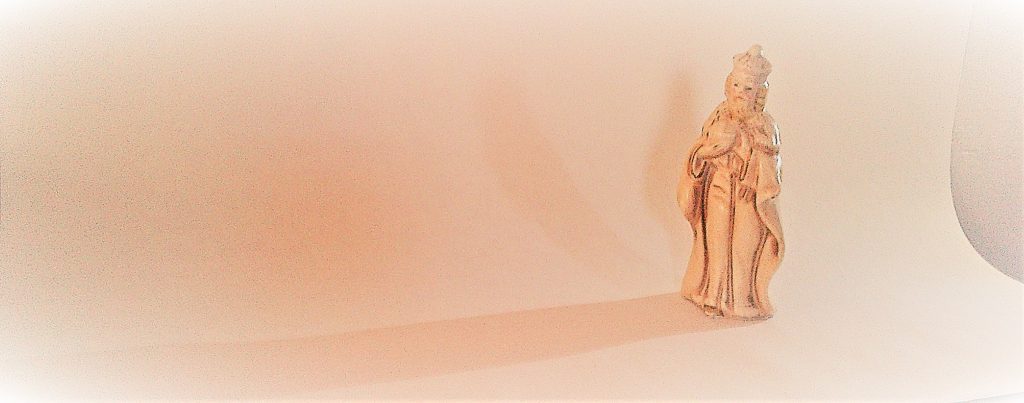
The main attraction for Francesca was the Nativity.

Not since St. Francis of Assisi assembled the first Nativity in Greccio in 1223, has there been such admiration for each and every witness who Our Lord assembled to adore His Son that first Christmas two millennia ago. Francesca kissed and hugged every shepherd, sheep, donkey, angel, and king. Most of all she adored the Holy family, calling Mary and Joseph, Ma-ma and Da-da, respectively. And Jesus, He was simply called: “ba-be.”

She carried them around the apartment. I did not want to ruin her fun, but they are ceramic. I explained a few times to be very careful.

“Gentle, Francesca…gentle…”, I harked a host of times.

Boom. To the wood floor went the shepherd. Amazing, grace held him intact. I took that as a great sign to put an end to her carrying the animals, angels and representatives of mankind.

I was fixing my coffee when I turned to see Francesca with Baby Jesus in her tiny hands. But He is so small, so tiny, what harm could come from holding Him? So I let her get away with carrying the Savior.

As I stirred my spoon Christ crashed to the floor, the tile floor. Francesca immediately looked at me, as if expecting all hell to break loose. I think I sighed but that was about all. It is Christmas, right? And it is, after all, only a ceramic figure purchased at Target.

After assuring Francesca not to worry and guiding her toward a few coloring books in the living room, I bent down to retrieve the broken Christ.

———

St. Francis was told by a Crucifix in an old abandoned chapel: “Restore my Church.”

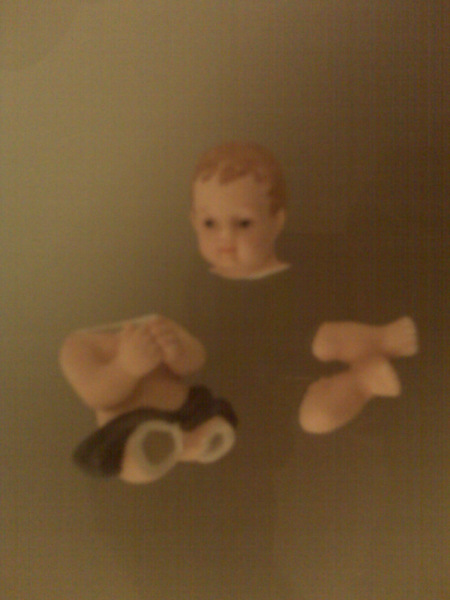
In my small one-bedroom apartment, I found Baby Christ, broken into exactly three: The Head, the Torso, and the Crossed Legs.

“Restore the Trinity,” was spoken to me.

———

For half of my forty years I can honestly say I have tried to pursue Truth, wherever it lie. In philosophy, in scripture, in literature, in art, in nature, in history…

Now, the entire Gospel of Christ lie naked on my kitchen floor.

We separate, we distinguish, we categorize, we breakdown. The Fall of Adam was a fall into denomination.

Christ’s body is One. His Church cannot be broken. Only mere men can get things so wrong.

I think of the great “Angelic Doctor” of the Church, St. Thomas Aquinas, who after spending a lifetime in unparalleled pursuit of human understanding, said after glimpsing a vision of what Our Lord has in store for those who love God:

“All that I have written seems like straw compared to what has now been revealed to me.”

Yes… “straw”…my brother Thomas…merely straw. Straw that lines the manger within which Our Savior is laid bare.

———

It is tradition to leave the crib empty until Christmas morning. Only then do we place the figurative baby Jesus into the scene, after all until that moment he was not yet brought forth from Mother Mary’s womb.

This Christmas morning I will glue together a Broken Baby Christ. The Head, the Torso, and the Crossed Legs will again be One.

Like the world after the birth of Christ, I will never be the same.

For what has now been revealed to me, no fall can break apart.


Howard Hain is a contemplative layman, husband, and father.
 

Standard
philosophy

Posture of Prayer

by Howard Hain
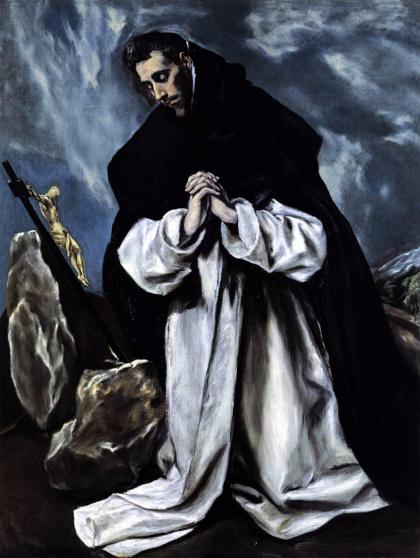
el_greco_st_dominic_in_prayer-1595

El Greco, “St. Dominic Praying”, c. 1588


Sometimes just showing up is all we can do.

To put ourselves in position to pray and worship—at least physically, even if we just cannot seem to get there spiritually—is an act of prayer and worship in itself. And quite often, it is the best we have to offer.

By confessing our aridity through physical obedience alone, we approach God’s altar with humility, for we come to God in our “nothingness”.

The bowing of head, the placement of knees, and the closing of eyes return us to the dark warmth of the womb. It is no coincidence that the posture of prayer and the fetal position bear great semblance.

It is in the womb that we are closest to God, furthest from the corruption of the world, and possess the least of what our “flesh” considers of value—our “brilliant” ideas, our “magnificent” plans, our “heroic” acts—our self-aggrandizement.

It is in the womb that we find ourselves in complete dependence. We receive all we need without knowing, without speaking, without cost.

In that sense, being in the womb is much the same as being in the world—for in the world we are still completely dependent—it is just that without the obvious reminder of the umbilical cord, we so easily forget our total and complete dependence on God, our Creator, our Sustainer, and our Ultimate End.

Hence we find ourselves “knowing,” “telling,” and “paying a price.” When in reality, the only thing that we can somewhat even come close to taking credit for is being physically present to receive His Word, His Wisdom, and His Will. All of which come free of charge, His Son having already paid the price.

————

“Lord, let me place my knees to the earth. Let me feel the foot of the cross against the caps of my knees. Let me close my eyes and bow my head. Let my brow lay upon your bloodied feet. Let me humbly raise my eyes to gaze upon your battered body. Oh my Lord and my God, let your blood and water rain down upon me.”

Amen.


Howard Hain is a contemplative layman, husband, and father.
Follow Howard on Twitter @HowardDHain

twitter.com/HowardDHain

If you enjoyed this post, please consider “liking” it, adding a comment, becoming an email subscriber, or passing it along via the social-media links below. Your support is greatly appreciated. Step by step. All for God’s glory.

Standard
philosophy

I’m Pro-Art

by Howard Hain
DT1554

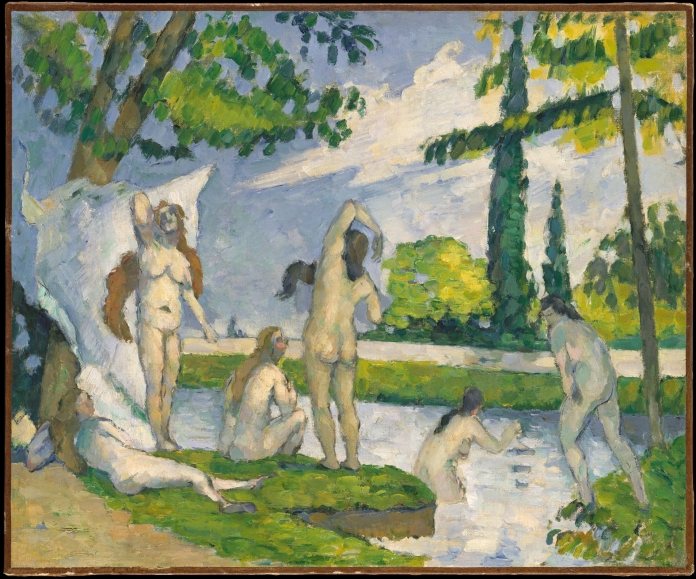
Paul Cézanne, “Bathers”, 1874-75, (The Met)


I’m Pro Art

In other words:

I’m Pro Truth

In other words:

I’m Pro Beauty

In other words:

I’m Pro Love

In other words:

I’m Pro Creation

In other words:

I’m Pro Life

(Oops, how’d that happen…funny how logic can lead you to such “un-expecting” places.)

(Words do seem to matter—or at least carry some weight—maybe even 7 pounds 8 ounces worth.)

(Before you panic, give it a little, teeny-weeny, infant-sized bit of thought…)

Conclusion:

ProArt (pro-creates) ProLife

ProLife (pre-conceives) ProArt

ProArt (equ=als) ProLife


Howard Hain is a contemplative layman, husband, and father.
Follow Howard on Twitter @HowardDHain

twitter.com/HowardDHain

If you enjoyed this post, please consider “liking” it, adding a comment, becoming an email subscriber (drop-down menu at top of page), or passing it along via the social-media links below. Your support is greatly appreciated. Step by step. All for God’s glory.


Web Link: The Metropolitan Museum of Art. Paul Cézanne, “Bathers”, 1874–75

Standard
philosophy

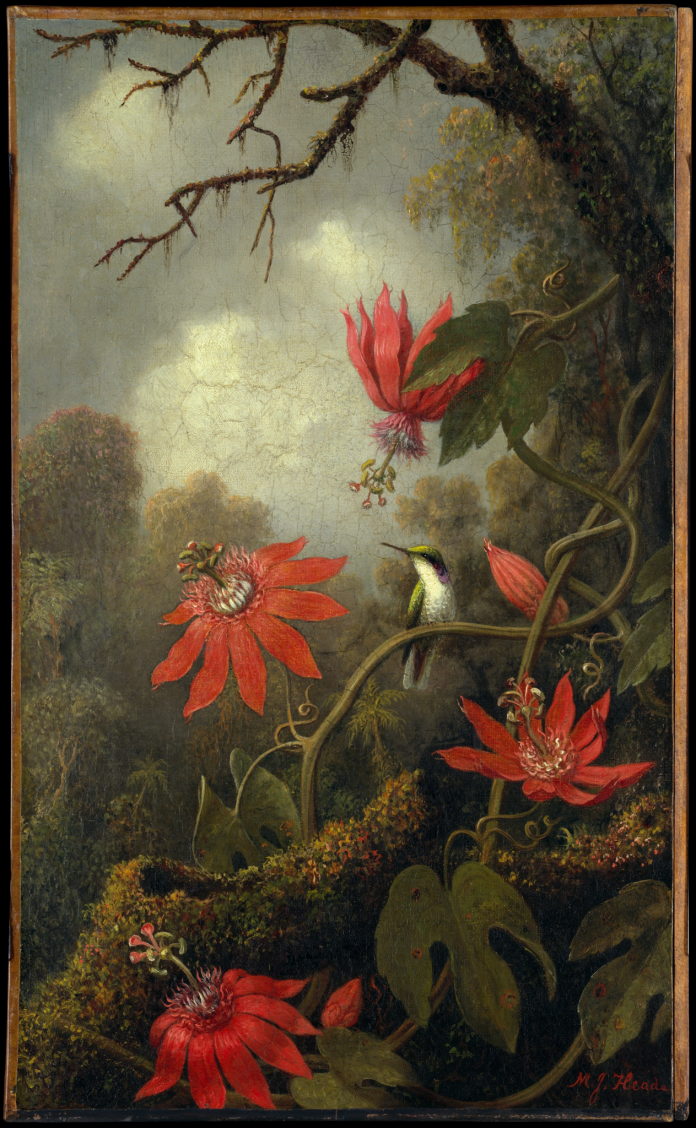
Hummingbird and Passionflowers

by Howard Hain
1509123983639705942327

Martin Johnson Heade, “Hummingbird and Passionflowers”, (ca. 1875-85) (The Met)

The delicate little bird that resides within each of us.

It hops to and fro. It stands startlingly still.

Very often we are the very ones who chase it away.

But it doesn’t fly far.

Just to the closest branch, that’s just beyond our reach.

And it looks back at us, as if to ask, “Why are you afraid?”

The tiny head of a tiny bird, slightly cocked to the side—a question mark floats from its beak.

It longs to return, to live within us, to build a nest, to raise its young.

But it doesn’t rush back.

No, it waits.

It waits for us to ask for it to return.

It’s a patient creature, that tiny bird.

One may be tempted to say it’s not very smart, but that’s not it at all.

It’s simple. It’s holy. It knows who it is. It’s not afraid of the fall.


Follow Howard on Twitter @HainDaily

If you enjoyed this post, please consider “liking” it, adding a comment, becoming an email subscriber (drop-down menu at top of page), or passing it along via the social-media links below. Your support is greatly appreciated.


Web Link: The Met Museum. Martin Johnson Heade, “Hummingbird and Passionflowers” (ca. 1875-85)

Standard