philosophy

Wise as Doves

by Howard Hain


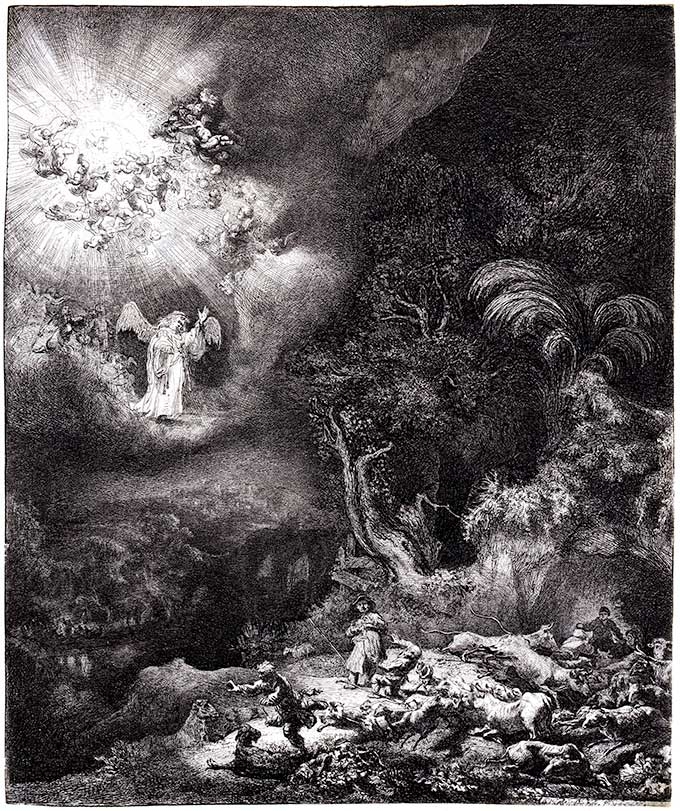
rembrandt-angel-appearing-to-the-shepherds-1634

Rembrandt, “The Angel Appearing to the Shepherds”, 1634


Now there were shepherds in that region living in the fields and keeping the night watch over their flock. The angel of the Lord appeared to them and the glory of the Lord shone around them, and they were struck with great fear.

—Luke 2:8-9


Perhaps the scariest thing to those of us who cling tightly to the things of the world is to accept the job that the Lord assigns us.

Oh, how so many of us are so quick to long for greater adventure!

Yet, when it comes to those humble, little shepherds to whom the angel of the Lord appeared, we are perhaps even quicker to long to be one of them—sitting quietly upon a gentle hillside, effortlessly tending to a passive flock, while the always-full moon provides a soft, ever-so-appropriate illumination from above.

But we are liars. For there’s nothing less romantic in each one of our daily lives, or more mundane. We simply have to be honest, or at least consistent. It all depends on how we look at it. If we see the shepherds in such a delicate light then we also need to see ourselves in the same. For before the angel appears, the shepherds were hardly posing for picturesque landscapes. Perhaps it is for this very reason—their realness, their authenticity, their holy simplicity—that the Lord chose them to be present when He revealed His glory.

It is exciting. We have a wonderful choice, then. Either our “boring” lives make us just the kind of people to whom God prefers to reveal Himself, or our lives are a lot more “exciting” than we ever imagined. Either way, what is vital to making such a decision is true sincerity and genuine gratitude. We need to thank God for who He has made us, for where He has placed us, and for what type of task He has assigned us.

A faithful, humble heart dreams and believes and sees great things among the most ordinary circumstances. Just look at the young virgin and the upright carpenter to whom the shepherds “went in haste” to find in a stable, adoring a child born within the company of the “lowest” of men.

If we spend our time dreaming of being someone else, living somewhere else, and doing something else, we miss the opportunity of being exactly who God intends us to be—and when that happens—we are always in the wrong place, at the wrong time, and most tragically, doing that which matters very little.

For to be the first on the scene, the first to “lay hold”, the first to adore the New Born King, is as good as it gets—even for those whose “normal existence” isn’t standing around all alone—day after day in the scorching sun or biting cold, while picking fleas from matted-down fleece or scaring off hungry wolves.


The angel said to them, “Do not be afraid; for behold, I proclaim to you good news of great joy that will be for all the people…”

So they went in haste and found Mary and Joseph, and the infant lying in the manger. When they saw this, they made known the message that had been told them about this child. All who heard it were amazed by what had been told them by the shepherds.

Then the shepherds returned, glorifying and praising God for all they had heard and seen, just as it had been told to them.”

—Luke, Chapter 2:10,16-18,20


Standard
philosophy

Mary’s Mother

by Howard Hain
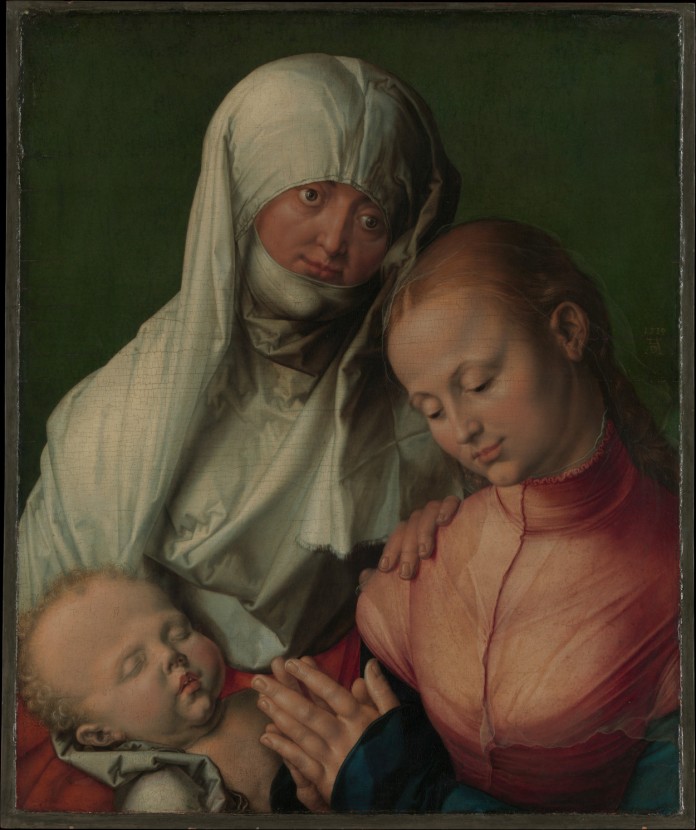
durer.jpg

Albrecht Durer, “Virgin and Child with Saint Anne”, ca. 1519 (The Met)


Christmas is a time for grandmothers.

They bake and cook and decorate. Their homes become mini North Poles, diplomatic outposts of Santa’s Castle.

At its core, Christmas is of course all about Jesus. All about Jesus, Mary, and Joseph. All about the Holy Family.

The Holy Family is an extended family though. And it doesn’t stop at grandmothers and grandfathers, aunts and uncles, or even cousins and distant cousins.

Just ask Saints Joachim and Anne, Zechariah and Elizabeth, or John the Baptist—not to mention all the unknown relatives whom the child Jesus surely encountered throughout His Galilean days. Ask any one of them about the far-reaching ripple effects of family grace.

Those touched by Jesus have a tendency to appear bigger than life.

Look at Santa Claus.

Most of us are aware that he is really Saint Nick.

But do we stop to wonder who Mrs. Claus really is?

I think she’s Saint Anne.

After all, Mrs. Claus is seen as everyone’s grandmother, especially when it comes to holiday cheer. But when it comes to truly celebrating the birth of Jesus, it is through Saint Anne that we approach the gates of Christ’s Nativity.

Mary’s Mother holds a special key. She is first among grandmas, first among those who pinch chubby cheeks, who pass along one more extra sugary treat.

———

Saint Anne help us. Speak to us. Show us how to be grand parents to all those around us, especially the little ones. Stir up the spirit of Advent. Bake away the holiday blues. Cook up a dish of Christmas love that only your hearth can serve.

———

Come one, come all, to the home of Saint Anne. Come with me to Grandma’s house for a holiday visit. Taste and see. Enter her kitchen, where the hot chocolate can always fit a little more whipped cream, where you hear the constant refrain: “eat…eat…eat…”

At Grandma’s your plate is never empty.

Her table is continually set.

She always sees Jesus as having just been born.

She is always wrapping Him up tightly in swaddling clothes.

It is simply grand.

To Grandma, Jesus is always an innocent child.

And she can’t help but see Him deep within both you and me.


Howard Hain is a contemplative layman, husband, and father.


Web Link: Metropolitan Museum of Art. Albrecht Durer, “Virgin and Child with Saint Anne”, ca. 1519


Standard
philosophy

Little Drummer Boys and Girls

by Howard Hain

Yesterday I witnessed a “dress” rehearsal for a live nativity. The cast was made up of first and second graders, and the audience was mostly composed of residents of a retirement home for religious sisters, Franciscans. It was spectacular.

Last week I was at Radio City Music Hall to watch the Rockettes in their “Christmas Spectacular”. It was quite a production.

Sitting in the dark this morning I cannot help but contrast the two.

I also cannot help but relate to the seven-year old who played the part of The Little Drummer Boy.

As that child walked so slowly toward the foot of the altar, where the rehearsal was being staged, I saw my vocation in an entirely different light.

The children were all singing their hearts out, and many of the eighty and ninety year-old sisters were mouthing the words. The boy with the drum didn’t utter a sound. He just kept walking, slowly, extremely slowly toward the altar, every once in a while ever so slightly pretending to tap two tiny sticks upon a toy drum. He was beautifully awkward.

There was no greater spectacle on earth at that very moment. Shall I dare to say, no greater event that heaven or earth has ever known?

For a child was born. We were all being born.

———

Come they told me, pa rum pum pum pum
A new born King to see, pa rum pum pum pum
Our finest gifts we bring, pa rum pum pum pum
To lay before the King, pa rum pum pum pum,
rum pum pum pum, rum pum pum pum,

So to honor Him, pa rum pum pum pum,
When we come.

Little Baby, pa rum pum pum pum
I am a poor boy too, pa rum pum pum pum
I have no gift to bring, pa rum pum pum pum
That’s fit to give the King, pa rum pum pum pum,
rum pum pum pum, rum pum pum pum,

Shall I play for you, pa rum pum pum pum,
On my drum?

Mary nodded, pa rum pum pum pum
The ox and lamb kept time, pa rum pum pum pum
I played my drum for Him, pa rum pum pum pum
I played my best for Him, pa rum pum pum pum,
rum pum pum pum, rum pum pum pum,

Then He smiled at me, pa rum pum pum pum
Me and my drum.*


Little Drummer Boy was composed by Katherine K. Davis, Henry Onorati and Harry Simeone in 1958.


Howard Hain is a contemplative layman, husband, and father.


Standard
philosophy

Broken Baby Jesus

by Howard Hain

(Note: This post was originally published on December 24, 2011.)

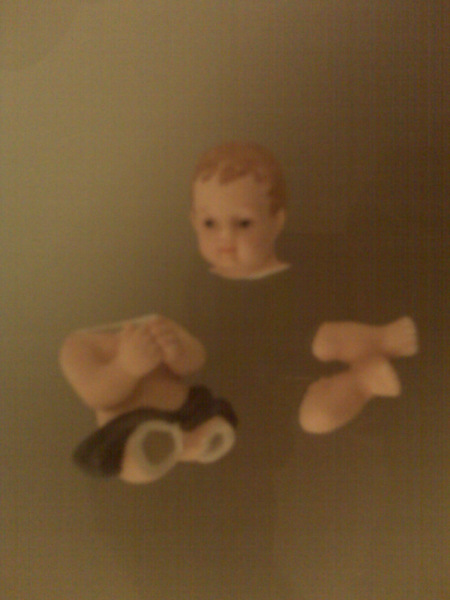
broken-baby-christ-2


We have not put up a tree in years.

For nearly a decade we have been moving—no longer than two years in any one house and no less than ten different not-so-humble abodes. Between and during the moves we were very much engaged with the world. A seemingly endless movable beast.

This December marks one year in our current house. I am happy to say it is our home. The Lord has blessed us with great peace. And with that peace comes a tree. A simple, well-shaped tree. Fittingly, a dear friend offered it to us as a gift.

Francesca could not be more ready to be initiated into the act of trimming. Before the tree arrived, her two-year-old fingers pointed out every tree, artificial or real, that graced the pages of a holiday flyer or the commercial floor of a Rite Aid or Dollar Store.

Up the stairs came the evergreen, into the old stand that has been in storage since my father last used it several decades ago. I cut off the mesh and out popped the branches.

We hung the lights and old glass ornaments that my mother-in-law washed a few days before.

The main attraction for Francesca was the Nativity.

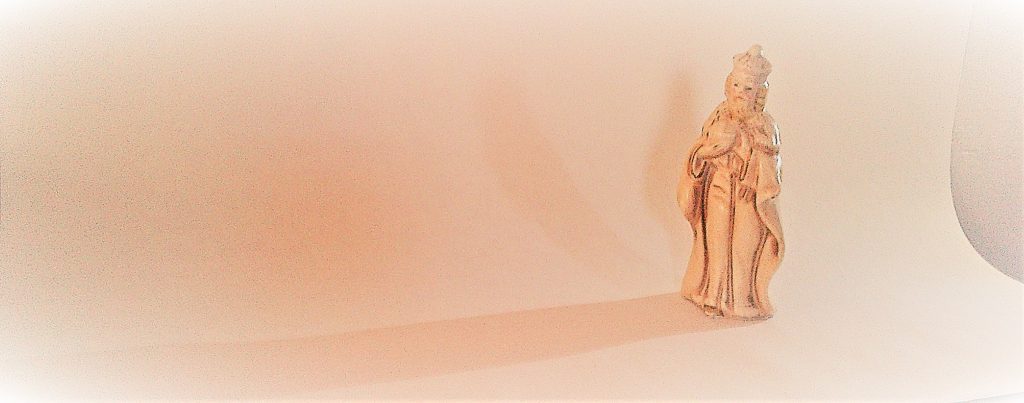
Not since St. Francis of Assisi assembled the first Nativity in Greccio in 1223, has there been such admiration for each and every witness who Our Lord assembled to adore His Son that first Christmas two millennia ago. Francesca kissed and hugged every shepherd, sheep, donkey, angel, and king. Most of all she adored the Holy family, calling Mary and Joseph, Ma-ma and Da-da, respectively. And Jesus, He was simply called: “ba-be.”

She carried them around the apartment. I did not want to ruin her fun, but they are ceramic. I explained a few times to be very careful.

“Gentle, Francesca…gentle…”, I harked a host of times.

Boom. To the wood floor went the shepherd. Amazing, grace held him intact. I took that as a great sign to put an end to her carrying the animals, angels and representatives of mankind.

I was fixing my coffee when I turned to see Francesca with Baby Jesus in her tiny hands. But He is so small, so tiny, what harm could come from holding Him? So I let her get away with carrying the Savior.

As I stirred my spoon Christ crashed to the floor, the tile floor. Francesca immediately looked at me, as if expecting all hell to break loose. I think I sighed but that was about all. It is Christmas, right? And it is, after all, only a ceramic figure purchased at Target.

After assuring Francesca not to worry and guiding her toward a few coloring books in the living room, I bent down to retrieve the broken Christ.

———

St. Francis was told by a Crucifix in an old abandoned chapel: “Restore my Church.”

In my small one-bedroom apartment, I found Baby Christ, broken into exactly three: The Head, the Torso, and the Crossed Legs.

“Restore the Trinity,” was spoken to me.

———

For half of my forty years I can honestly say I have tried to pursue Truth, wherever it lie. In philosophy, in scripture, in literature, in art, in nature, in history…

Now, the entire Gospel of Christ lie naked on my kitchen floor.

We separate, we distinguish, we categorize, we breakdown. The Fall of Adam was a fall into denomination.

Christ’s body is One. His Church cannot be broken. Only mere men can get things so wrong.

I think of the great “Angelic Doctor” of the Church, St. Thomas Aquinas, who after spending a lifetime in unparalleled pursuit of human understanding, said after glimpsing a vision of what Our Lord has in store for those who love God:

“All that I have written seems like straw compared to what has now been revealed to me.”

Yes… “straw”…my brother Thomas…merely straw. Straw that lines the manger within which Our Savior is laid bare.

———

It is tradition to leave the crib empty until Christmas morning. Only then do we place the figurative baby Jesus into the scene, after all until that moment he was not yet brought forth from Mother Mary’s womb.

This Christmas morning I will glue together a Broken Baby Christ. The Head, the Torso, and the Crossed Legs will again be One.

Like the world after the birth of Christ, I will never be the same.

For what has now been revealed to me, no fall can break apart.


Howard Hain is a contemplative layman, husband, and father.


Standard