philosophy

Walled Garden (2)

by Howard Hain

[Note: This is part 2 of a work entitled “Walled Garden”. To read part 1, please click here:  Walled Garden (1)]


pissarro orchards at louveciennes 1872

Camille Pissarro, “Orchards at Louveciennes”, 1872


And from that hour the disciple took her into his home.

—John 19:27


On leaving the convent I came upon the friar whom I had noticed on my way in. The little dog was no longer around. We approached each other as if we had met before. He was kind. He was middle-aged. He was simple. And then the strangest thing occurred. He took me by the arm, the way men stroll in Italy, arm-in-arm, during the evening passeggiata—the evening stroll.

But I had never met this man before.

Yes, it is certainly strange to have an unknown man approach you and link his arm in yours.

He led me toward a dirt path. We strolled. We spoke little. He didn’t speak English and my Italian was tiny. But it was nice. Peaceful. It didn’t feel strange. I only now use that word, for from a somewhat forced “objective” perspective, it seems that it had to be.

He was a man of God. And he saw I was too, before I had any idea God had undeservedly entrusted me with such a gift. The gift of loving God. The gift of wanting Him more than I could ever explain. The gift of being an outcast here in this world of time, a wanderer, a pilgrim, a crusading knight of Lady Poverty—of being—in yet again, some strange kind of way—a lady-in-waiting—patiently and painfully anticipating the exuberant arrival of the one and only eternal groom.


He brought me to what appeared to be an old foundation. I understood from what few words we exchanged that this was the remains of an abandoned orphanage. And then we began to head back toward whence we came. I remember offering him some bread that I had in my bag, purchased that morning in the city of Assisi up above. He lightly touched his stomach with one hand and shook his head “no”—a kind, polite, gracious, and utterly grateful, “no-thank-you” kind of “no”.

When we arrived at the door of the convent I understood from his gestures that he was inviting me to see something inside. It was clearly something that I had not yet seen. I motioned “yes” and we entered. We climbed a staircase and walked down a hallway. We were in an area not open to the public. The walls revealed its age. And we approached a door. A wooden door. And he unlocked it with an old large skeleton key. He opened the door and motioned for me to go inside, quietly informing me that this is Saint Clare’s cell. I entered and he remained outside. He gently pulled the door closed.

I wasn’t sure what to do. I was safe. I knew I wasn’t locked in. I was pleasantly confused. I looked around. It was small. It was literally a cell. Enclosed. All stone. A low tight arched ceiling. Bright. Dark. Cozy. Warm. Beautiful.

A tabernacle. A womb. A virgin’s womb.


At the end of the somewhat rectangular shaped room was a small alter-like shelf. I knelt before it. I have not the slightest recollection of what I prayed.  Of what I thought. Of anything spiritually taking place. I was just there. And I remained a few minutes. And then I left. I opened the door and I was all alone. No friar. I closed the door behind me and made my way back down from where I had come.

It seemed as if nothing extraordinary had happened. It was all so normal. So everyday. Yet it was nothing of the sort. It was extraordinary. It was an encounter. I think. Perhaps.


I think of little Mary. Alone in her room. I think of a gentle breeze and the sight of a bowing angel.

“Hail, full of grace…”

What a name, what a title to be given!

Gabriel holding the key that opens the door.

The young, chosen, highly-favored virgin agrees to hear his message, to walk arm-in-arm with him, to accompany him to she knows not where. She agrees to accept God’s invitation.

The Holy Spirit comes upon her simple life, her simple way, her simple manner.

The power of the Most High overshadows her daily existence.

Our Father confirms her trusting posture, her grace-filled instinct to utter the purest of prayers:


“Behold the handmaid of the Lord; be it done to me according to thy word.” (Luke 1:38)


Jesus entered a private, off-limits room. He made His home there.

And He never left.


“…when you pray, go to your inner room, close the door, and pray to your Father in secret…”

—Matthew 6:6


(July/16)
Standard
philosophy

Cat under a Hot Tin Roof

by Howard Hain


My daughter wants to be a cat.

Like with most kids, the formal structure of school, day after day, can create a desire to wander freely about the house, one hour into the next, no schedule or agenda, simply playing, humming, and exploring as she goes. A cat’s life viewed in this light can certainly seem attractive. Francesca loves the idea of staying home all day, sleeping soundly in sunny spots, and most of all, the tranquil adventure of discovering little nooks in order to curl up and hide away.

I don’t blame her. And she and I have discussed it several times. After all, the desire to curl up and hide away is pretty universal. It resurrects consoling memories and secure sensations: The womb. Fetal position. Warmth. Safety. Seclusion. Protection.

I think it’s safe to say that voluntary hiding spots—especially those involving blankets, quilts, pillows, and/or stacks of sweaters—invoke great emotional, psychological, and spiritual comfort. And physical comfort goes without saying.

I shared with Francesca a little secret. I want to be a cat too. Well, that’s not really the secret. This is: I am a cat. That got her attention—as displayed by a raised eyebrow and a curious smile. “No, it’s true,” I told her. “Especially when I go to church.” Now this really got her attention. “Yes, when I go to the chapel I become like a little cat…and during Mass I wander around the altar, slowly, very slowly, looking for just the right space to curl up and hide away. And I find it. I always find it. But I also have to wait for just the right time. Because this special little crevice is not always open.” She asked where it is. I let her in on it: “You know the gold box behind the altar?” Yes, she nodded. I told her it’s called the tabernacle, but this she apparently already knew, and she made a point of making that very clear. Well anyway, I asked her if she ever noticed that the tabernacle door was left open during a certain part of Mass. She acknowledged that she already knew this too, but this time with a little less certainty. “Well, that’s where I go,” I nodded. She smiled and made a funny face. “It’s true, I’m telling you…I wait for the door to open and then I quietly climb in.” She liked this. She really liked this. So do I.

She thought about it a little bit and had to confess that a cat would really love a little cozy space like that, especially our kitty named Clive. “He’d definitely try to get in there if the door was left open!”

But she was also a little curious if you could get stuck in there if the door was closed after you got in.

I assured her that God would never trap a kitty like that.

She agreed again.

“You’re right, Daddy, God would never trap a kitty, especially not with Jesus inside!”


Standard
philosophy

Still Life with Hands

by Howard Hain


Holding hands in the park

Holding hands with yourself

God holding hands

Your hand

Within yourself

The mortal and divine

Hand in hand

One bench

Word and flesh

Father and child

Husband and wife

Creator with creation

Holding each other

Now one hand

Shall we just sit and rest a while?”


(Jan/18)

Standard
philosophy

Sunday Vespers: Head of an Old Fisherman

by Howard Hain
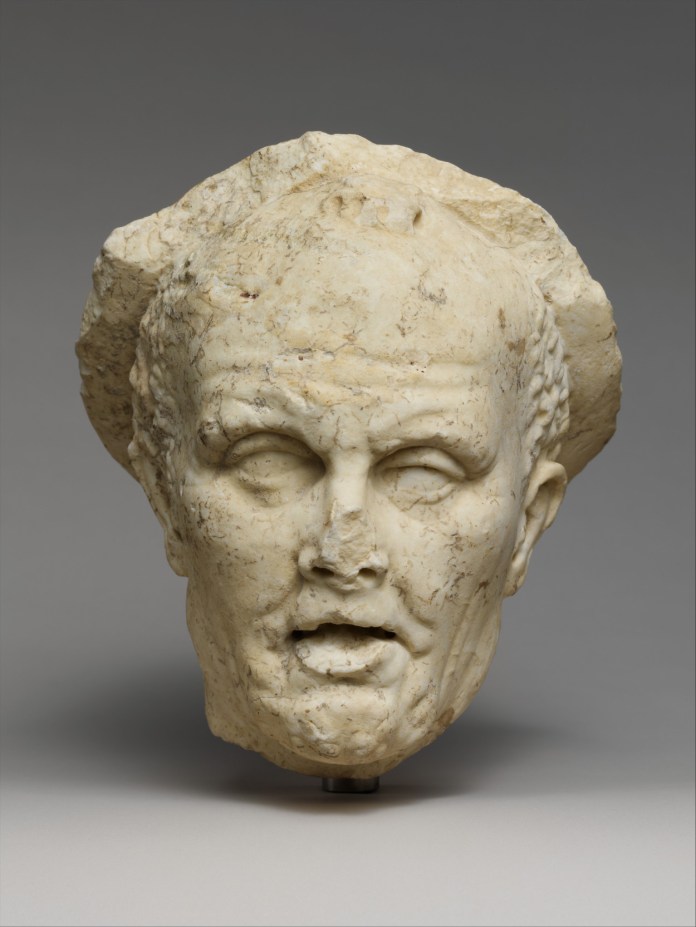
marble-head-of-an-old-fisherman

“Marble Head of an Old Fisherman” 1st-2nd century A.D.  Period: Imperial. Culture: Roman. Medium: Marble. (The Met)


I’ve seen your face before.

We’ve spent time together before today.

You are so beautifully broken.

Made of marble, yet fragile as clay.

The years have chiseled deep.

The salt air has sanded away.

I hope one day to look just like you.

Yes, I know, it’s a lofty goal.

The calm countenance of a wise, humble, seasoned priest.

O, yes you are!

I see right though that meager disguise.

A fisherman, a priest; they’re practically one and the same.

Saint Peter, Saint James, Saint John…

The Fisher-King kept those three extra close.

Plus, your hat gives it away.

Chipped or not, I know it’s really a halo.


“Come, follow me…and I will make you fishers of men.”

—Matthew 4:19


Web Link: The Met, “Marble Head of an Old Fisherman”

(Sept/16)

Standard
philosophy

Playing Around

by Howard Hain

bruegel-childrens-games-1560

Bruegel, “Children’s Games”, (1560)


…and a little child will lead them.

—Isaiah 11:6

———

It’s the simple moments. It’s playing hide-and-seek. It’s pretending what isn’t is.

Like a game made-up as we go, with only a single rule: It has to make us laugh.

But not the kind of laughter that hurts anyone or anything. No, it has to be true laughter, the kind that comes from and through kindness, through truly wanting to be with one another—so much so that we’ll make up just about any old game, just as long as we won’t have to go our separate ways.

“Life” then becomes one big beautiful “excuse” to stay together, and our “actions” take on a tremendously meaningful fashion. They become like soft pieces of colorful clothing gently placed upon our joy-filled affections.

Little children know this through and through. They’re constantly changing and tailoring their “clothes”, adapting and accessorizing as they go, with only one goal in mind: for the “fun” to continue. But the fun they seek is not the kind that you and I normally desire—for little children know what few adults remember. They’re not so easily tricked. They know that fun, true fun, has very little to do with the actual game being played, in and of itself. For little children it’s all about what the game, as a mere instrument, allows them to experience—the freedom to let out love.

That’s why the type of game they play can turn on a dime. It just doesn’t matter.

Rules? Scores? Time-limits?

Who cares about stuff like that?

Are we “laughing”? Are we having “fun”? Are we still “with each other”?

Are we still in love?

These are the only questions that matter to a small child.

And with prayer it is much the same. Saints make up all kinds of “games” in order to “excuse” the time that they want so desperately to spend with God. They play all kinds of little games. They slide beads, they sing little songs, they pretend to be statues while playing hide-and-seek with the Lord, and some—the ones that the world most often calls crazy—even dream up little tales and fanciful stories, imagining along with God what could be if only everyone in the world would join in and play together.

But this is no big secret. All saints in one way or another come to say the same thing: Every technique, every approach, every means of entering into prayer…each and every one…they’re all part of one giant “excuse”, one seemingly never-ending “game”. For at the end of the day, techniques and approaches are at best a mere prelude to divine laughter—that infant-like sound composed of pure joy, that only the Love of God can bring into being.

———

He said to them, “Let the little children come to me, and do not hinder them, for the kingdom of God belongs to such as these. Truly I tell you, anyone who will not receive the kingdom of God like a little child will never enter it.” And he took the children in his arms, placed his hands on them and blessed them.

—Mark 10:14-16


(Jan/8/16)

Standard
philosophy

Time with John

by Howard Hain


“I am the way and the truth and the life.”

—John 14:6


I am”         =   INCARNATION

“the way”    =   CRUCIFIXION

the truth”  =   RESURRECTION

the life”      =   ASCENSION

The INCARNATION is the CRUCIFIXION and the RESURRECTION and the ASCENSION.

The Word Made Flesh—God Made Man—is Crucified Love, Raised From The Dead, Sitting at the Right Hand of God The Father in Heaven.


Incarnation

Crucifixion

Resurrection

Ascension

“Glory”


Step by Step.

A Five Stage Plan.

Happening All At Once.


Keep it Holy.

Keep it Simple.

Keep it “Unbelievable”, or in other words: A Matter of Faith.


Not understanding is half the battle, the other half is not needing to.


Pure Faith Sets Us Completely Free.


(Nov/17-Jan/18)

Standard
philosophy

Stop and Go

by Howard Hain

“1010 WINS”

If you grew up in the Tri-State Region, commonly known as the greater New York City area, you know the sound of “1010 WINS”, the radio station that reaches millions living in New York, New Jersey, and Connecticut, especially those sitting in traffic.

“Traffic and Transit on the Ones”

Every ten minutes, “on the ones” as they say, comes the coveted traffic report, including mass transit (train and subway) updates, and of course all the action one needs to know about the “bridges and tunnels”.

What a nightmare commuting can be.

Stop and Go.

“YOU GIVE US 22 MINUTES, WE’LL GIVE YOU THE WORLD”

That’s what we hear, while sitting in our cars, or as we get prepared to sit in our cars—or perhaps board buses, trains and/or subway cars.

Twenty-two minutes, that’s all they need, and we’ve got it all: breaking international news, politics, weather, sports, culture, and of course, traffic and transit “on the ones”.

Of course those twenty-two minutes give us everything we need, except relief. Thanks to them we are now very well-informed people sitting in traffic, as opposed to complete and utter ignoramuses actively stuck behind Greyhounds.

“Top and Bottom of the Hour. The Beginning and the End.”

There’s another great news agency constancy at work in the Tri-State Area. Its broadcast begins at the top and the bottom of the hour. But there’s only one message. The news is always good. And it always leaves one relieved.

New York, New Jersey, and Connecticut are filled with parishes. Most established by the immigrants of their time. And today they march on:

The Liturgy—The Great Prayer of God’s Church—won’t be stopped.

Day in, day out.

It is always the hour.

“YOU GIVE IT 22 MINUTES, IT’LL GIVE YOU MORE THAN THE WORLD”


(Jan/27/17)

Standard
philosophy

Wide Open Spaces


20180110_110701

Francesca H. (2017)


The Beauty of Solitude

The Beauty of not being afraid to be alone

Of knowing God always resides within

That His Creation rests all about

Inside and Out

Outside and In


Love God in all Creation.

Love all Creation for God’s sake.


Play

Draw

Write

Sing

Dance

Be Free

That’s why Jesus died


You are a Child of God

Redeemed by the Blood of the Lamb

Co-Heir to Christ’s Glory *


* For those who are led by the Spirit of God are children of God.

For you did not receive a spirit of slavery to fall back into fear, but you received a spirit of adoption, through which we cry, “Abba, Father!”

The Spirit itself bears witness with our spirit that we are children of God,

and if children, then heirs, heirs of God and joint heirs with Christ, if only we suffer with him so that we may also be glorified with him.

—Romans 8:14-17 (NABRE)


by Howard Hain, drawn from the artwork above

Standard
philosophy

Sketch, Self-Portrait (2017-18)


The joy of finding oneself a simpleton

Of finding it all terribly complicated

I can handle only so little

Anymore than necessary seems such a bore

Almost as if complexities make me sneeze

Simplicity…simplicity…please…

Some may smirk

Or even find it quaint

But to me there’s no other way

The greater the grace the less the choice

I’m simply stuck on play

Can hardly see why it shouldn’t be

Interest rates?

Property values?

Health insurance?

Seems like such a waste of rhyme and reason

I prefer to not desire

Benefits package? O please

401ks and dividends?

Look at the birds and the bees

I’ve had enough to say

Chirps and buzzing are all I need

Enough, enough, with complexities

More mac and cheese, please


—Howard Hain


(Nov/17-Jan/18)

Standard
philosophy

Instrument of Peace

by Howard Hain

jean_francois_de_troy_christ_carrying_the_cross_and_a_subsidiary_study_d5529612h

Jean Francois de Troy (1679-1752), Christ carrying the Cross, study


When Jesus had received the sour wine, he said, “It is finished,” and he bowed his head and gave up his spirit.

John 19:30

———

The Cross is merely an instrument.

For there is nothing inherently painful about the trunk of a tree.

It is not the Cross itself that crucifies.

But there is something about the Cross that leads us either to death or to life.

It is our relationship with that piece of “wood” that ultimately colors our perception of earthly existence and its inherent sufferings.

And Christ shows us the way.

For there has never been a man more at peace than Christ Jesus upon the Cross—for there has never been a man more aligned to the will of The Father.

Yes, from the eyes of the world it was complete chaos. It was an utter mess. Destruction. Torture. Shame. Disappointment. A mockery. But from Heaven’s perspective it was complete fulfillment. It was utter completion. It was wholeness. It was oneness. It was unity. It was Shalom.

For Christ knew the joy set before Him.

Yet He who existed before time did not manipulate time in order to escape what was in reality unspeakable pain.

And that is what He teaches.

Not to deny the pain. Not to even to avoid it. But to experience it from within the realm of His Kingdom, and as He Himself tells us, that Kingdom “is within”, that Kingdom “is at hand”.

That Kingdom is here and now when there is no separation between God’s child and His will.

Christ shows us this through His Passion.

He shows us that it is our relationship with those crisscrossed beams that makes carrying them either hard and heavy or “easy” and “light”.

He shows us that all our joy depends on our relationship with suffering—with our relationship with The Cross—with our relationship with The Tree of Life.

Our Father has given us free will in order to make a simple choice. To love or not to love…and “greater love has no one than this: to lay down one’s life for one’s friends”.

We love one another by dying for each other—by “spending” our lives in service of one another—and the Cross is the bridge that allows us to span that exchange.

The Cross is merely an instrument.

———

“For the joy set before him he endured the cross, scorning its shame, and sat down at the right hand of the throne of God.”

Hebrews 12:2


(Jan/16)

Standard