philosophy

Dressing for the Day


When you take off your clothes are you afraid of where they go?

Do you fear the place your clothes are laid?

Are you more concerned with the placement of your hat, shirt, pants, and shoes than you are of your body?

Obviously not. Although, we may take good care of our clothes. Hang them neatly. Fold them carefully. Push them down softly into a laundry bag.

We may even hold some dear to our hearts.

A wedding gown. A military uniform. A first-communion dress. Fabric entities such as these we often show respect, handle with extra care, hide away in safe places—when in reality they are no longer of much practical use at all.

Our bodies move on, independent of previous cloth. To be washed, fed, laid into bed…prepared for a new day.

The same can be said of our souls.

When you take off your body are you afraid of where it goes?

Do you fear the place your body is laid?

Are you more concerned with the placement of your head, shoulders, knees, and toes than you are of your soul?

Better not.

In reality it is no longer of any practical use at all.

The body is removed from the soul.

The soul marked by faith and wrapped in hope begins an ascent.

The body to be shown respect, handled with extra care, hidden away in a safe place.

Our souls move on, independent of particular flesh. To be washed, fed, tucked into bed…clothed for the ever-lasting day.


—Howard Hain


(Mar/5/2018)

Standard
philosophy

Innocence Itself


A small, beautiful child.

What could be more innocent?

The tiny face of one born a few days before.

What could be more pure?

At what age does that stop?

When is it that we no longer see an innocent child, but instead, just one more man or woman walking the crowded streets?

If the child is our own, probably never.

Parenthood is a gift.

A gift beyond telling.

Yet every person we shall see this day was once a child.

Every person we shall see this day is still a child.

A small, beautiful child.

What could be more innocent?

The tiny face of one born a few days before.

———

Can you imagine what Saint Joseph felt?

What it was like to hold Jesus in the crook of his arm?

To present Innocence Itself to the world?

———

True humility has little to do with wanting to be humble.

It has nothing to do with wanting to look small, tiny, and somewhat sad.

True humility comes through grace.

The grace of knowing that no matter what you do, no matter how hard you try, you on your own cannot stop innocence from being slaughtered.

———

Somewhere, right now, the infant Jesus is being rejected.

Saint Joseph can hardly believe it:

Here He is. The Son of Man. Please don’t do anything, don’t say anything, don’t even think anything that offends His dignity.”

———

The next time we are tempted to judge anyone perhaps we should remember that.

Perhaps we should use our imagination, our faith, our hope, our love—all the gifts and talents that come from God, that return to God, but that God Himself lends us for the time being—to find a child.

For wasn’t that very person, the one who is about to be judged, once too only a few days old?

———

Think of Saint Joseph holding Innocence Itself.

Think of Saint Joseph humbly holding a tiny child, a tiny innocent child reaching out to all mankind with outstretched arms—so innocent that it’s hard to even imagine that all the world, that each and every one of us doesn’t immediately reach back with all our might to tenderly embrace this most precious gift—the most precious gift that a guilty world could receive.

Innocence Itself.


—Howard Hain


(Oct/2016)

Standard
philosophy

Short and Simple

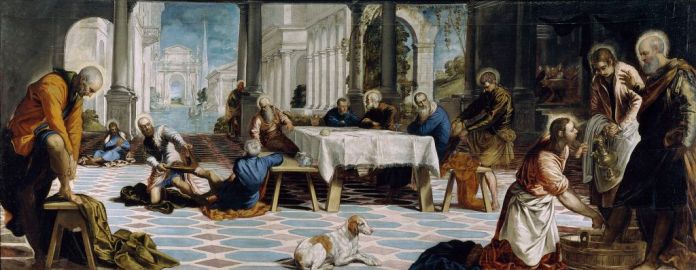
tintoretto-christ-washing-the-disciples-feet-1548-49

Tintoretto, “Christ Washing the Disciples’ Feet”, 1548-49


Pray, brothers and sisters,

that my sacrifice and yours

may be acceptable to God,

the almighty Father.”


Tall and handsome.

Big and powerful.

Profound and exciting.

A great adventure starring a great hero.

Doing the dishes.

Just the right combination of hot and cold.

Mostly hot of course.

And the cold, that splash of sobriety so we don’t get burned.

In the Name of our Lord Jesus Christ crucified, I commence the dishes…

———

The sponge is important.

It need be clean and effective.

For how can one wash with something dirty?

And yet, even the best is hardly perfect.

After a single use it’s bound to show signs of deterioration.

So you add more soap and hope for the best.

Our Father, who art in heaven…

———

The circular motion of water, upon and around each dish.

Turn, turn, turn…

Rinse, rinse, rinse…

Like the axis of the earth.

The equator slightly tilting back and forth.

Side to side, to ensure proper runoff.

Such a delicate balance.

Then put aside to dry.

Sunlight works best.

Hail, full of grace, the Lord is with thee…”

———

The drain cannot be ignored.

The little netting, catching all sorts of iniquities.

Now very clean hands.

Cleansed thru humility.

The dignity of work.

Reach down.

To grab what has been left below.

The rejected, the unwanted, the forgotten food.

A Eucharistic portion.

Not washed into the drain.

Yet separated from what is considered clean.

Lord, I am not worthy that you should enter under my roof, but only say the word and my soul shall be healed.”

———

I find two towels work the best.

One, somewhat clean, to wipe down the faucets and the edge of the sink.

The other to dry shriveled-up hands.

And to be hung, upon the little bar.

The one that crosses the oven door.

Awaiting the warmth.

The warmth that bakes our daily bread.

May the Body of Christ keep me safe for eternal life.”

———

It is all really very simple.

Short and simple.

He died. We live.

We die. He lives.

One dirty dish at a time.

One Eucharistic encounter at a time.

Go in peace, glorifying the Lord by your life.”


Thanks be to God.”


—Howard Hain


(Feb/3/17)

Standard
philosophy

My Father’s Son


Paolo_Veronese_-_Portrait_of_Count_Giuseppe_da_Porto_with_his_Son_Adriano

Paolo Veronese, “Portrait of Count Giuseppe da Porto with his Son Adriano” (1720)


It was the end of a day.

I’d say “long day” but that would be melodramatic.

It was the end of a day. A day, like most, occupied with the busyness of life.

I was in the kitchen and I made a quick motion with my arm. I smelt something.

It is my father.

I’m back in my parents’ orange-wallpapered kitchen in suburban Long Island. I’m about 5 or 6 years old. My father came home from work a few minutes ago. He’s sitting at the head of the kitchen table, getting ready to eat or smoke a cigarette. I stand by his side, leaning against him, one half of my small buttocks on the edge of his chair, my side against his side, my face just under his outstretched arm.

I am my father’s son.


—Howard Hain


(Mar/12)

Standard
philosophy

Running with the Lord

by Howard Hain

cezanne-bather-with-outstreched-arms-1878

Paul Cezanne, “Bather With Outstretched Arms”, 1878


Years ago when I was living in San Francisco, a group of us used to go hiking out in Marin County, just across the giant red expanse of the Golden Gate Bridge. We went often. A group of both men and women, mostly single, mostly without a care in the world. I think every one of us was under thirty, or thereabouts.

My favorite part was running down. Don’t get me wrong, the hike upward was terrific too, that’s when we discussed ideas and dreams and laughed almost all the while, breaking up into smaller groups of two or three or maybe even four, and then drifting back together—like a herd of elk, for they too have not a care in the world—only to once again drift apart, this time usually paired up with a different companion or combination thereof. None of it was planned or had any real intention of course, it just happened: laughter, ideas, silence, stops, gazes outward, waiting, speeding up, sipping water, laughter, drifting apart….it was divine.

Like the elk, it all seemed to be instinct.

But something special happened when we reached the top. After we reached the top. After we caught our breath, removed our backpacks, and viewed the scape. After we had eaten a little snack or a small sandwich, something light, usually along with an apple or granola bar, maybe even a small handful of assorted nuts and a few of those purple chips that all San Franciscans seem to love. It was time to descend.

My friends used to laugh and say that it was because I’m an Indian. They would go on and on about my “Cherokee” blood, and the fact that the first three letters of my first name spelled “how” only served as additional fodder. But there was some truth in it. Not only because I actually do have some American Indian blood, but more so because at that time I was very much a native. Primitive. Raw. Free.

That’s why I would run down.

I loved it. I would run as fast as I could go. Cutting back and forth, hopping over logs, propelling myself around turns by pivoting hard on the corner tree. I loved it. I loved the way I felt. I loved that my weight added to the speed, that what normally would slow me down, would normally make me huff and puff, now drove me forward, propelled me toward whence I came.

It was wonderful. I was free. I was free. I was free. It was the closest this man ever came to flying.

This morning, almost twenty years later, in urban New Jersey—just across the Hudson River from Manhattan—I went for a jog. They just opened a new circular path around the old reservoir resting slightly higher than its surrounding cities of Weehawken and Union City. It is very pleasant.

I wasn’t sure how far I’d be able to make it. And after a very short distance I thought to myself, “Oh boy, I’m gonna have to stop already.” But I didn’t. I thought about posture. I thought about positioning of hands. I thought about breath. I quickly realized that the Lord has taught me much.

The posture of prayer is important. How we position ourselves is powerful. And breathing is everything.

I made it around three times. I smiled almost all the way. My pace was pretty good. I did alright, not bad for a man I thought just a few minutes before was getting old. I think even the newly-minted goslings admired my gait. And even if they didn’t, it was nice to be in a place to think that maybe they did.

I walked a lap and then began to make my way back toward my home, my one bedroom apartment that I share with my most recent and till-death-do-us-part hiking companions: my beautiful, delicately strong bride of twelve years, and my precious little girl, who at six-and-a-half runs and laughs like the wind.

I was a few streets away, coming down 18th and crossing Summit, when it happened. I never really noticed it before. The next two blocks were a steady, fairly steep decline. I began to run.

I loved it. I ran as fast as I could go. Cutting back and forth, hopping over the cracks in the sidewalks, propelling myself around the turn by pivoting hard on the corner stop sign. I loved it. I loved the way I felt. I loved that my weight added to the speed, that what normally would slow me down, would normally make me huff and puff, now drove me forward, propelled me toward whence I came.

It was wonderful. I was free. I was free. I was free. It was the closest this man ever came to flying.

For a moment I thought I was on the outskirts of San Francisco.


(May/16)
 

Standard
philosophy

Desire Unknown

OLYMPUS DIGITAL CAMERA

El Greco, “The Holy Family with Saint Mary Magdalen”, (1590-1595), detail of face of Virgin Mary


You know what I desire, Lord.

An unspeakable desire.

An indescribable desire.

An unknowable desire.

I desire You.

Yet, You I can not speak of, can not describe, can not know.

Your great gift to me is my desire for You, for what I can not speak of, can not describe, can not know, can not even desire without the grace you deliver.

I desire Your desire.

I desire You.

Have Your way.

Fill me with desire for You.

Burn me with Your desire for Yourself.

Turn me inside out.

Let Christ be seen.


—Howard Hain


(Feb/16)

Standard
philosophy

A Day Among The Stones

by Howard Hain

christ-on-the-cross-murillo-1660-70

Murillo, “Christ on the Cross”, (1660-70) (detail)


some were stones

others rocks

the difference

i’m not quite sure

though both are heavy


so many distinctions

almost all

humanly made

yet not even

a single

grain of sand

is created by man


perhaps then

stones are former rocks

those chosen to enforce

worldly power

perhaps they’re earthly kingdoms

established by men

men possessing

such domain

perhaps they’re the ones

reigning down

upon those brought low

upon those dragged

outside the walls

hauled off to a yard

to be stoned


yet both

both stone, and rock

seem to get along

as long as they’re simply left alone

call to mind

that famous pile

that most famous pile of stone

the one upon which

we crucified our Rock


to some it’s golgotha

to others it’s calvary

to too many

it’s a giant farce

but oh those stones

oh they don’t lie

and all those rocks

they build up the church

o, those stones, o, those rocks

yes, both big and both small

they keep straight

the vertical beam

upon which is nailed

the weight of the cross


it’s You of course

Father

who holds it all together

it’s You of course

Father

who provides all the strength

who holds up Jesus

for the world to see

the entire world

as You hold

those wooden beams

that stretch

to the ends of the earth

much like You taught

good saint joseph

that just and upright man

to hold Your child Jesus


o good saint joseph

everyone’s patron saint

break your silence

tell us then

tell us of that day

the day your Jesus

was crucified

speak o strong man of stone

you who speak

thru so many silent statues

chiseled to show forth

the birth of our salvation


for you saint joseph

are not only

the foster father

but also a stand-in

for the cross

for you are still there

you are still there to be seen

yes, saint joseph

you are at the crucifixion

playing a role

yes, Father God has taken over

but you joseph

are certainly present

for the crucifixion

is still a portrait

of the Holy Family


dear joseph

you reside in the wood

the scent of which

fills Jesus’ earthly suffering

it’s the scent of the workshop

the scent that Jesus breathed

His entire youth

especially when asleep

against your heart

good saint joseph

a just man

just home from work

your clothing covered in dust

the dust from the saw

cutting thru raw wood

it’s in this sense

that you joseph are present

in the sights and sounds

of the first domestic church


the clanging of hammer against nail

driven thru His hands and feet

Jesus thinks of joseph

the joy of work well done

the importance of finishing well

while all the while

the hard unrelenting

stone below

kisses His mother’s knees

consoling Jesus

reminding Him

and all of us

of the stability

of a truly godly home…


What a day among the stones!


Jesus, Mary, and Joseph, pray for us.

Glory be to the Father, and to the Son, and to the Holy Spirit…


(Mar/16)

Standard
philosophy

Not Worthy

by Howard Hain

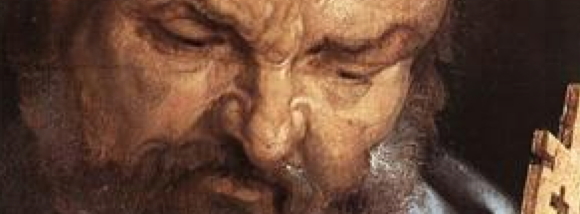
albrecht-durer-saint-peter

Durer, “The Four Apostles” (1526), detail of St. Peter


When Simon Peter saw this, he fell at the knees of Jesus and said, “Depart from me, Lord, for I am a sinful man.

Jesus said to Simon, “Do not be afraid; from now on you will be catching men.”

When they brought their boats to the shore, they left everything and followed him.

—Luke 5:8,10,11

———

It is our job, perhaps our only job, to continually put ourselves into a perspective—in a relation to Christ—that causes us to truly believe with all our hearts, all our souls, and all our minds that we are not worthy of His sacrifice, His gift, His love for us as embodied in the Crucifixion and His glorious wounds—and then to share that “divine unworthiness” with all our hearts, all our souls, and all our minds with every brother and sister of Christ we cross.

For it is truly the most “unworthy” of news that best delivers the Good News.

———

“The centurion said in reply, “Lord, I am not worthy to have you enter under my roof; only say the word and my servant will be healed.”

—Matthew 8:8


(Jan/16)

Standard
philosophy

Love Your Proud Papa


Today, This Moment, The Year of Your Lord

My Child,

I thought I should write you this morning. To put down a few words. To speak into creation my ongoing love for you.

There are times when I watch you, somewhat at a distance. I leave that space so that my watching doesn’t impede your playing. But there is really no space at all. Because by not being “right with you” I get to see you as you truly are. My “distance” allows me to see you within the full scope of your existence. And never forget, my child, not for a second, I create your existence. It is not an event of the past. I am active. Always. I am always creating you, and I am always enjoying my creation. That is why I watch.

I watch you unfold. I watch frowns and frustrations unfold into smirks and full-blown smiles. I watch you evolve and grow. I watch you transform. I watch you fight then make up. I watch you get hurt then heal. I watch you hoard then share. Of course there are many times, my dear child, always in fact, that I want to jump in and save the day, to stop the fight, the hurt, the misunderstanding before it even begins. But I love you too much to always deny you such good food and such nutritious drink.

I will your existence moment by moment, and my will is love. I know exactly how much you need to digest in order to provide for your perfect growth. I also know when too much of one nutrient or the denial of another is not part of my overall plan.

Perhaps that is the hardest thing about being a father, knowing that your maximum freedom within the ever-expanding bounds of my love is what you most need. Such liberty leads you into the divine individuality that I ultimately will to be achieved. And it’s also what makes you most valuable to our one, united, and very common family.

True liberty is what makes you most like me.

Please enjoy my gift this new day.

That’s what I will.

Enjoy my love. Enjoy your freedom. Enjoy the play of keeping it all within bounds. For you should also know—your freedom without my love is a very dangerous game. A game that as much as it grieves me to see any of my children play, I must allow, if the freedom I gift to you is to be of any value at all.

I am always with you. And know this too—and know it for sure—if at any one moment you choose to use your liberty to call out my name, I will scoop you up before you can even utter “the smallest letter or the smallest part of a letter” of my most hallowed name.

For the distance between us isn’t real at all.

It’s love. It’s everywhere. And it lasts for eternity.

I seal this with a kiss. I place it upon the palm of my hand.

I hold it out and gently blow it your way.

I love you…my dear child.


Always smiling at you,

Your Proud Papa


(Jan/17)

Standard
philosophy

The Bad Thief

by Howard Hain

rembrandt-self-portrait-c-1668

Rembrandt, “Self Portrait”, c. 1668 (detail)


The Bad Thief


good thief
bad thief
Savior in between
how is it
that you and i
can be all three?

we know of Jesus
as perfect
as perfect can be
speaking faith
breathing forgiveness
the Word
bound up
still
completely free

we know too
of the good thief
turning
turning toward Goodness
our Goodness
so gracious
hanging there
tortured
beside him
beside the good thief
Jesus nailed
one with the tree

we know too
what happened
what happened then
to the prodigal thief
humility
contriteness
a humble heart
spurned not
yes
true repentance
sorrow for sin
painful sorrow
paid forth
by a sinless man
and God
God the father
accepting the fee
the precious blood
of Jesus Christ
setting him
the good thief free

but what
what of the other one
what of the thief
named bad
what of him
unrepentant
deserving to hang
what of that poor man
that poor
prideful soul
just like you and me
that poor
nameless sinner
just like you and me
also hanging
hanging there
hanging above Mary
and the disciple
Jesus loved
hanging there
upon a third
a third
rarely talked about tree

who is he?
but you and me

i am the bad thief

and so are you

i have stolen
stolen so much

especially time

what have you
in your pocket
that isn’t thine?

Jesus makes it
perfectly clear
what happens
what happens to thieves
thieves like us
who simply say
i’m sorry
yet even His promise
His promise
full of mercy
His promise
of paradise
of paradise in fact
that very day
doesn’t stop
his good thieving legs
from being smashed
his repentant body
completely broken
head to toe
no
not even Christ’s promise
the promise
from the King Himself
removes the good thief
from the gift
from the gift that is his cross

but what of the other one
what of you and me
what of us
thieves who also lie
who reject justice
Justice hanging
right next-door
what of the bad thief
can be redeemed
what of the bad thief
in you and me
God only knows

mercy
mercy
mercy
Father
upon the dead
both the living
and the deceased
mercy
mercy
mercy
Father
upon us all
upon Your children
Your children turned thieves
whose faith
and sorrow
is known
by You
and You alone

good thief
bad thief
Savior in between
how is it
that you and i
and all the rest
of all humanity
can lack
to such a degree
true repentance
true humility

good thief
bad thief
Savior in between
how is it
that you and i
are all three?


(2016)

Standard