philosophy

On the Cutting Edge of Boredom

by Howard Hain

vincent-van-gogh-the-stone-bench-in-the-garden-at-saint-paul-hospital-1889

Vincent van Gogh, “The Stone Bench in the Garden of Saint-Paul Hospital” (1889)


There is so much “excitement” in the world.

Politics. Sports. Entertainment.

Even in the simple act of kids going back to school there is so much hoopla.

We can’t just do things simply. Everything has to be planned, announced, delved into, broadcast into something “grand”, “life-changing”, “utterly profound.”

But the more we need to insist that something is the case, the less in reality it usually is. For excitement, like authority, is something that by its very nature announces itself—and it decreases in direct proportion to the need to have it proclaimed.

In other words, just because we make “a big deal” about everything doesn’t mean it is. In fact, it is normally quite the opposite.

———

I remember when a child’s birthday party was composed of eight or ten kids sitting around a kitchen table, wearing silly pointy hats, and eating a Duncan Hines cake made the day before by a stay-home mom.

Even catechism lessons seemed a whole lot more straight forward, and effective. For me they took place around that same kitchen table, with those same neighborhood friends, and were taught by that same mom who baked the birthday cake. Now, catechists are expected to act like game-show hosts. And preachers? We’ll they’re expected to be downright celebrities.

Well, there is an answer to all this triviality: The Bench. Whether it’s in the park, in front of your house, or even under one of those little bus-stop canopies on the side of the road.

Sit. Listen. Do nothing. Especially when you are tempted by “boredom”. For that’s exactly what boredom is, a temptation. A temptation to deny the existence of God. For if we are conscious of God’s presence we can never be bored. Every nook and cranny of every “meaningless” daily act and encounter has profound, truly profound significance, if we are conscious of God’s omnipresence and His perfect will.

Sit there peacefully, resting quietly on the cutting edge of boredom. You never know how much good God might do through you: what poor widow you may accompany, what orphan you might help find a home, what angel you may entertain, what authentic prayer you might offer up—now that God and not self-image is in control.

———

Truth flips things on their head. I think it is Saint Bernard who says something along these lines: If we really think about how radical a call the Christian life is, as compared to the way the rest of the world lives, we realize it’s almost the equivalent of us walking down the street on our hands.

If it isn’t Saint Bernard that I’m paraphrasing, well then it is one of God’s other saints, and that is all that matters. For in God’s Kingdom the only credit that is given comes from and returns to God, and God alone. All wisdom is His.

And there it is, there is the crux of it: We have become obsessed with being “original”, with being “special”, with being “one-of-a-kind”—which of course we all are, tremendously so in fact—that is until we stop and think about it, or even worse, try to achieve it through our own means.

Trying to be “original” is the end of all originality. Wanting to be “special” is the death of a truly special purpose.

Pure existence on the other hand can only result in true originality—and it is always special, no matter what Tom, Dick, or Harry it is taking place within.

———

When a human being is existing as God wills, the result is vigorous, powerful, truly exciting.

And God never wills for us to believe and act as if we are God and He is not.

Put to death once and for all the need to self-promote, to self-proclaim, to self-worship.

Sit on a bench instead.

Be still.

Exist.

You just may be surprised how cool you really are.


(Sept/2016)

Standard
philosophy

Tiny Rose

by Howard Hain

renoir-girl-with-a-hoop-1885-detail

Renoir, “Girl with a Hoop”, 1885 (detail)


When my little girl wakes up in the morning she looks like a little rose. A little pinkish-red rose. Her cheeks are just that color. Her skin is so soft and delicate. The sweetest, most tender expression shines forth. Her dark, long, think, and perfectly disordered hair—just like her mother’s—wonderfully frames and presents her perfect little features. And her tiny, sleepy voice usually calls out the sweetest one-word query and request: “Daddy?”
.
She could ask for just about anything at that moment, at that precious waking moment, that awakening of innocence itself, of genuine and true affection—that annunciation of a pure and powerfully unquestioning love for a man she trusts with her entire little being to meet all her needs, defend her from all her fears, and make her laugh.
.
It has been a humbling seven years and a few months, for she is now six-and-a-half. Her entire life, in the womb and within the world, have brought this arrogant, selfish man to his knees.
.
God has never shown such love as in making Himself a small child, a rosy-cheeked little boy, waking and calling out in perfect faith: “Daddy?”
.
Jesus is my Lord and Savior, my God.
.
The Blessed Virgin Mary is most certainly my mother.
.
But Saint Joseph is my merely-human hero. That just and righteous man, who trusted in God and His holy angels, is often on my mind these holy, joyous days.
.
For Easter is a time of renewal, of rebirth, a time of innocence, a time when tough guys become little lambs. It is a time when tears that flowed from despair, disappointment, and death are collected into baptismal fonts and poured over the tender little brows of newborns, while proud parents, godparents, grandparents, relatives and friends—just like Joseph and Mary, Zechariah and Elizabeth, Joachim and Anne, and a little cousin perhaps, like the recently born John the Baptist—stand close by and can’t help to smile, can’t help to shed a tear, can’t help to laugh out loud and pat each other on the back or fling an arm over a shoulder, while standing extra close as the family portrait is taken.
.
Easter is a season. Seasons come and go. So do years. So do childhoods. So do generations. But what never passes away is the Word of God. And that Word is made flesh each and every time we see the Divine Presence in another human being, whether that person is just like us, or not at all.
.
Stand up the next time someone walks into the room. Take off your hat. Bow your head. Give thanks that you have been found worthy to be in God’s presence and for the opportunity to minister to Him. For God is surely present, as surely as He is in you and me.
.

(April/2016)
Standard
philosophy

Joy Friday

by Howard Hain

The best part of getting a gift is the opening and receiving.

No matter how grateful we are to have the gift, the excitement of “having” is never equal to the excitement of “opening” and “receiving”.

Christ’s death is the gift.

The actual hour of the agony, the arrest, the abandonment, the trial, the mocking, the spitting, the carrying, the nailing, the hanging…it is all the “unwrapping”. The unwrapping of a great gift, the greatest gift.

Because we know the resurrection happens. That it has happened. We live post-resurrection.

The gift is the death. The unwrapping the method of the torture.

Good Friday is the closest we come to being alive during his dying process.

The Liturgy falls down.

“I AM” is too big.

Heaven will not allow distance. The Liturgy in all its greatness is still a distance.

No liturgy. No sacraments.

Heaven is total Union.

Heaven on earth is the unwrapping and receiving of the greatest gift.

Heaven on earth is the joy of Jesus being tortured. The joy of Jesus dying.

‘Paradox’ is too little of a word.

‘Mystery’ means nothing in relation to the reality.


“…he left the cloth behind and ran off naked.”

—Mark 14:52


Standard
philosophy

Speak Life

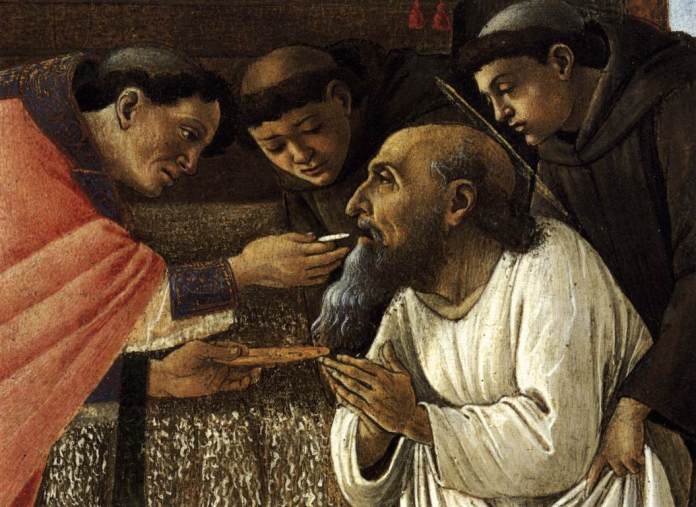
sandro-botticelli-the-last-communion-of-saint-jerome-early-1490s-detail

Botticelli, “The Last Communion of Saint Jerome”, early 1490s, (detail), The Met


Heal us.

In the form of bread.

Our tongues like cribs.

You come to rest.

A sacred place.

A mother watches.

A father can hardly believe.

Greatness simply conceived.

Silent.

Yes let us be.

Help us not to speak.

No words can be.

No thoughts except those that flee.

Yes.

Hold our tongues.

Into quiet place.

Stillness.

Let us wait.

Till hear You cry.

A hungry child.

Tucked in for night.

A drop of milk.

In reality blood.

In the form of wine.

The angels sing.

Holiness explodes.

Heaven down to earth.

Saints to and fro.

Blessings forth.

Grace abounds.

The sick are healed.

The blind can see.

The lonely find friends.

Children unwanted?

They finally reach home.

We look.

We see.

We wonder.

How could it be?

It’s Him!

It’s Him.

Right there.

The One nailed to the tree.

Alive again.

Within my mouth.

And at my right hand.

And to the left.

And straight ahead.

And there!

Yes, there too!

In that hopeless situation.

We thought all was lost.

But, no, it’s Him.

He really does care.

And He calls us over.

To Himself.

And yes.

Silence changes forms.

It’s again time to speak.

What else can we do?

The Eternal One.

The Son of Man.

The Conqueror of Strife.

Let us smile at one another.

Let us speak life.


—Howard Hain


(May/2017)

Web Link: Botticelli, “The Last Communion of Saint Jerome”, The Met

Standard
philosophy

Le Madras Rouge

by Howard Hain


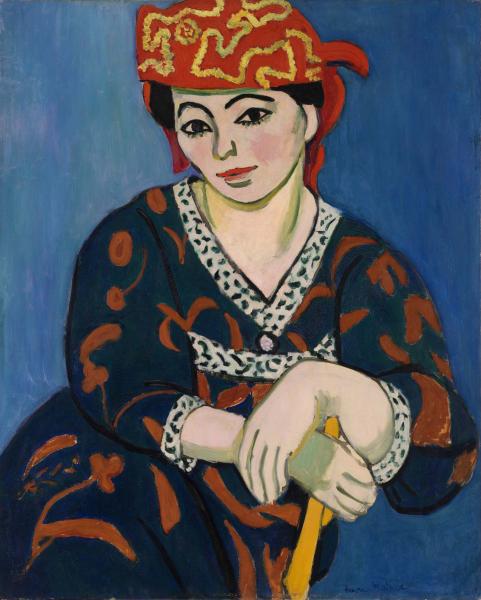
henri-matisse-red-madras-headdress-le-madras-rouge-1907

Henri Matisse, French, 1869-1954
“Red Madras Headdress (Le Madras rouge)” 1907, Oil on canvas, The Barnes Foundation


Rosy cheeks

Crimson lips

A funky handkerchief upon your head

Taking a break from cleaning?

Or just pretending?

Ah!

Perhaps a gypsy?

No, perhaps all three.

———

Yes

More to be seen

A portrait from the past

A figure of old

A testament

Of what’s redeemed

A harlot

No more

Seven demons

Cast away

Setting sail

Completely freed

Eyes on distant shores

Flag full staff

Bones properly buried

A pirate turned parakeet

Pastels all a flutter

Colors abound

Novelty renewed

A romance for sure

Mysterious winds

Exotic islands

Far off lands

Yet so close

Milk and honey

Set before

Within arm’s reach

Right and just

An adopted child

Now full heir

———

Innocence discovered

Virginity returns

Chastity on full display

Fact as fiction

Stories unfold

Promises foretold

A man and then a woman

A rib and a garden

A paradise and nothing to do

A lie and a sneaky snake

A revolving sword

Set a fire

Brother against brother

An ark that floats

Sent off in twos

A raven and a dove

A father in faith

Journey unknown

A far-flung place

Boys will be boys

Brotherly mischief

Here we go again

Slavery and sphinx

Mercy tries once more

Thru the red gate

Chariots and legions

Encased in sea

Wandering and wandering

“Listen to me!”

Bread from heaven

Fowl falling from the skies

Striking rocks

Water shoots forth

Time to settle down

Conquer some giants

Crisscross a river

An ark on two poles

A new occupied land

Vineyards and fields

Laws and oaths

Judges and kings

Forgetting and forgetting

Just who it is

Who gives them life

What is God to do with such a man?

The shepherd boy

Last in line

One more try

Singing psalms

Prophecy

He fits the mold

The mind of Christ

We are told

———

A tiny young woman

A just upright man

Stables and sages

Stars and circumcision

“The carpenter’s son?”

Yes, crafting a table

To stand upheld

Shape of a cross

Used too as a crib

A born-again bed

For those about to die

Back to a table

A kingdom spread

A feast to behold

The Son not spared

The Bread of Life

Broken and blessed

“Father forgive them…”

“They know not what they do…”

———

Mary of Magdala

First to the tomb

Her and the gardener

Alone and renewed

“Mary”

“Rabboni!”

“Don’t yet cling to me”

“But what then shall I do?”

Sit and stare

Inwardly explore

Externally ignore

Signs of the past

Others still may see

But within your chamber

Mine all mine

Extra virgin

The Garden of Eve

Betrothed and beautified

Originality set free

No trace of sin to fall

Now cover your hair

You are my bride!

For you I shall return

A dove within a cleft

Won’t be left alone

———

A handmaid

A wife

A disciple

A model

A muse

Positioned in a cane-back chair

Awaiting the Word

To open the door

Now

Yes now

An acceptable time

Behold

“I stand”

“I knock”

“I AM”

Open the door:

“Lift high your heads…”

“Grow higher, ancient doors…”

“Let him enter, the king of glory!”


henri-matisse-red-madras-headdress-le-madras-rouge-1907

Henri Matisse, French, 1869-1954
“Red Madras Headdress (Le Madras rouge)” 1907, Oil on canvas, The Barnes Foundation


(June/2017)


Web Link: Matisse, Le Madras Rouge, Barnes Foundation 


Standard
philosophy

The Best Coinage The World Has Ever Known


You can run but you can’t hide. An apple a day keeps the doctor away.

What a world it would be if we only spoke in clichés.

Is it the kind of world you and I live in?

Do we retreat into beaten-down meadows, like deer who lay where others have already flattened the grass?

There’s less work I suppose. And the grass may still be warm.

But it’s also kind of like Goldilocks and the Three Bears.

You can enter a home that isn’t yours, you can search for a bed that fits just right, but at the end of the day your cover will be blown.

You can run but you can’t hide.

After all, you’ve made your bed, now lie in it.

Perhaps it is such lying that is really the apple.

For picking fruit from someone else’s tree has never been a good idea.

Those kind of apples certainly keep the good doctor away.

But I guess we also have to be careful to not over-correct.

We must not out of pride be unwilling to enter where others have already been.

No, that is wisdom. We should go where others have gone before. It just depends on who they were and where they went.

And no matter what, we shouldn’t hide within those spaces, pretend that they are our own, and perhaps worst of all, act as if we are the first to ever have entered—delusion of this kind leads us to the belief that we create anything at all.

We don’t.

Think of Adam in the Garden. God is busy whipping up the entire universe from out of nothing. Creating and sculpting, adding and adapting, breathing life into His new world. And Adam, well, he’s one of the building blocks. Yes, certainly a favorite. A favorite that God does not want to be alone.

And something spectacular takes place:

The LORD God said: It is not good for the man to be alone. I will make a helper suited to him. So the LORD God formed out of the ground all the wild animals and all the birds of the air, and he brought them to the man to see what he would call them; whatever the man called each living creature was then its name. The man gave names to all the tame animals, all the birds of the air, and all the wild animals… (Genesis 18-20)

God created, Adam named.

It is simply amazing. And humbling.

What an honor. And what a clear indicator of who is truly in charge.

We create nothing. That’s the bad news for those who want to be God.

We do though participate in the ongoing unfolding of God’s perfect and eternal world. We even seem to share the leading role. That’s the Good News for those who believe.

For our work is not to create. We simply can’t. Only God can. And even if we “build” with what is already in existence, if we seemingly “create” something “new” with the building blocks we find already lying around, that “pseudo-creation” still isn’t our primary job.

Then what is?

Well, the original disciples of Jesus had a similar wonder:

So they said to him, “What can we do to accomplish the works of God?” Jesus answered and said to them, “This is the work of God, that you believe in the one he sent.” (John 6:28-29)

And there’s the crux of it, if you will.

Adam, we must remember, when in the supremely honorable position of naming God’s creatures was still naked, and he felt “no shame.” He hadn’t yet eaten what wasn’t his. He was not yet hiding “among the trees of the garden.” He still believed in the One Who Sends.

Adam was faithful. Adam was original. Adam knew he was God’s creation. And Adam was free to roam.

But Adam used his freedom to choose to become a slave.

Adam’s fall was a fall into self. A fall into creation, the creation of a great lie, that man creates on the same level as God.

It was a great fall. So steep was the cliff off which he went that no other story could ever bring more meaning to the most hackneyed line: “Once upon a time…”

Adam’s fall is a fall into denomination.

A fall into the church of self.

A fall into complete and utter cliché.

And it brought death to the great privilege of cooperating with God, of naming and stewarding on His behalf His created world.

But thanks be to God.

For someone truly original, and creative, finally came round.

He put the apple back up upon the tree and told the snake to take a hike.

His name is Jesus.

He is also called The Son of Man.

But of course we are free to just call Him God.

For about Jesus, nothing is cliché.

It is very clear, there’s absolutely no running or hiding when it comes to the Cross.

And when it comes to His love for us, there’s no apple that can keep the Divine Physician away.


—Howard Hain


(Jan/17)

Standard
philosophy

Portrait of the Catholic as a Middle-Aged Man

DP158522

Georges Seurat, “Aman-Jean (Portrait of Edmond Francois Aman-Jean)”, 1882-83, (The Met)


So much is not seen.

What is heard hardly tells the story.

The hairline leaves little to gaze upon.

A good sergeant, he worries little about appearances.

He often feels what he believes is slipping away beneath his feet.

The commands barked from above seem detached from the situation on the ground.

He follows orders anyway.

To many he is somewhat of a joke.

A puppet. A man who can’t think for himself.

Some may even use the word ‘coward’.

But none of this is accurate of course.

No, he is a man of honor.

A noble-man.

He takes his vows and commitments seriously.

He will protect his wife. He will raise his children.

He will stand when others hide.

He will walk forward when others turn away.

Firm and steadfast.

He lives out daily the faith of his fathers.

Quietly and efficiently as possible.

No, he’s certainly not perfect.

And of this he is very conscious.

So much so he wonders often if God has chosen the wrong man.

And this is saving grace.

Humility is purgatorial.

It burns away the dross.

It polishes the trophy.

It propels him to love to heroic measures.

It keeps him around, in the game, engaged, alive, an active participant.

As much as it hurts, he knows it’s true, and he carries on, toward the goal.

Toward what he cannot see, toward what he certainly does not understand.

This man is a hero of faith.

And at the same time he is just another Joe.

Another Tom, Dick or Harry.

But in heaven, when all is said and done, he shall receive a crown.

His cross finally laid down, he shall finally see it as a walking stick.

A beautifully-crafted staff in the hand of a just and upright man.

A righteous upholder of God’s eternal law.

Then he shall take his place, very close to the King and Queen, right beside that other unknown man named Joe.

That common nobody led by angels and mocked by men.

The one chosen by God to raise the Messiah.

For where you find the anonymous man of whom I speak, you too shall discover the Holy Family.

Jesus, Mary, and Joseph

Joseph, Mary, and Jesus.

On earth as it is in heaven.

A little humble home in the middle of nowhere.

An eternal kingdom emanating all that is good.


—Howard Hain


Web Link: Met Museum of Art


(Dec/2016)

Standard
philosophy

Man of Fruitful Sorrows


Burned by the sun

No more features

No longer identified

Swollen, firm, upright

About to explode

A moment more

A single cry

The world is saved


—Howard Hain


(Mar/2018)


Standard
philosophy

The Inner Room


The inner room is built of earthen means.
.
Framed by wooden beams.
.
Criss-crossed they hold the ceiling high.
.
A floor of dirt and stone below.
.
Iron shards hold angles in place.
.
Windows a mixture of air and sand.
.
The walls, they depend on culture, time, and place.
.
The door is always the same.
.

—Howard Hain
.
.
(Mar/2018)
.
Standard
philosophy

Listening Note 1


‘Speak, LORD, for your servant is listening.’

—1 Samuel 3:9


What is listening?

It is being passive.

But not everyday, run-of-the-mill passivity—not the kind achieved by man’s own will.

It is passivity that cannot be “achieved”.   Ever.   At all.   By mankind.

For it is active passivity.

Truly active. Truly passive.

But not a balance between the two. Not an evenly leveled scale, not an equal “score” of “5” for each. Listening is not a scientific or sociological accomplishment, nor is it a mere relationship between two contrarieties to be deemed healthy or valid by human means.

Listening is fullness.   A state—a becoming—a verb.   A noun—a subject—the ultimate adjective.

It is complete existence. It is pure life-giving action and it is pure passive reception—it is simultaneous conception and birthing—a total liberated consummation—to the entire degree—the maximum—and beyond.

Life and Death. Resurrection and Ascension. Glory and Praise.

It is achieved— “accomplished”— “brought into being”—by Grace—and the poverty of truly unworthy participation.


We love because He first loved us.” (1 John 4:19)

(We listen because He spoke us into existence.)


You did not choose Me, but I chose you.” (John 15:16)

(We did not ask to listen, He invited us to hear.)


God always makes the first move: The Unmovable Mover.

God always utters the first sound: The Unspeakable Speaker.

He silently gestures, “grace upon grace”.

Calling for us to use freewill.

Bravely. Boldly. Beautifully.

To actively choose—to “volunteer”—to be passively crucified.

Nailed to the tree—driven into place—into pure passivity.

To Listen.


The LORD said to Samuel: I am about to do something in Israel that will make the ears of everyone who hears it ring.

—1 Samuel 3:11


—Howard Hain


(Jan/2018)

Standard