philosophy

Slavery


Three small frying pans. Methodically. Step by step. A young black man behind an omelette station.

“Good morning, sir, what would you like?”

Eyes cast down. Polite.

———

“Depart from me, Lord, for I am a sinful man.”

———

Fault of our father’s?

Timid. Afraid. Of me? Of the world. Of his story.

“Mr. Gorbachev, tear down this wall!”

A good boy. A handsome young man. Strong. Going to be tall. Unconscious potential.

But those eyes. Terribly cast down. That speech. Overly polite. His posture. Shoulders down and rounded forward. All three spoke: “I am not worthy…”

The fear of man. The fear of me. The fear of himself.

“Good morning, sir, what would you like?”

But it’s not my fault. Then again nor is it his. Yet, both are moot points—for at the beginning of the day—he’s still fettered.

He can walk, but he can’t run.

Still the crowd. You coward. Their omelettes can wait. Tell him he’s wonderful. That you want to be friends.

Kiss his beautiful brow.

Tell him.

“Raise your head, son of man, receive God’s blessing!”

“Stand-up straight. Chin toward the sky.”

“You’ve bowed long enough.”

———

The kiss of peace. One man to another. One knowing he’s been undeservedly set free. One not knowing he is even held captive.

A young black man smiles.

“Thank you, sir.”

Three one-dollar George-Washington bills lay beside a bin of multi-colored vegetables.

Me and my omelet walk away.

A ham-n-cheese garden delight.


—Howard Hain


Standard
philosophy

The Land of Make Believe

by Howard Hain

andrei-rublev-the-trinity-1411-or-1425-27

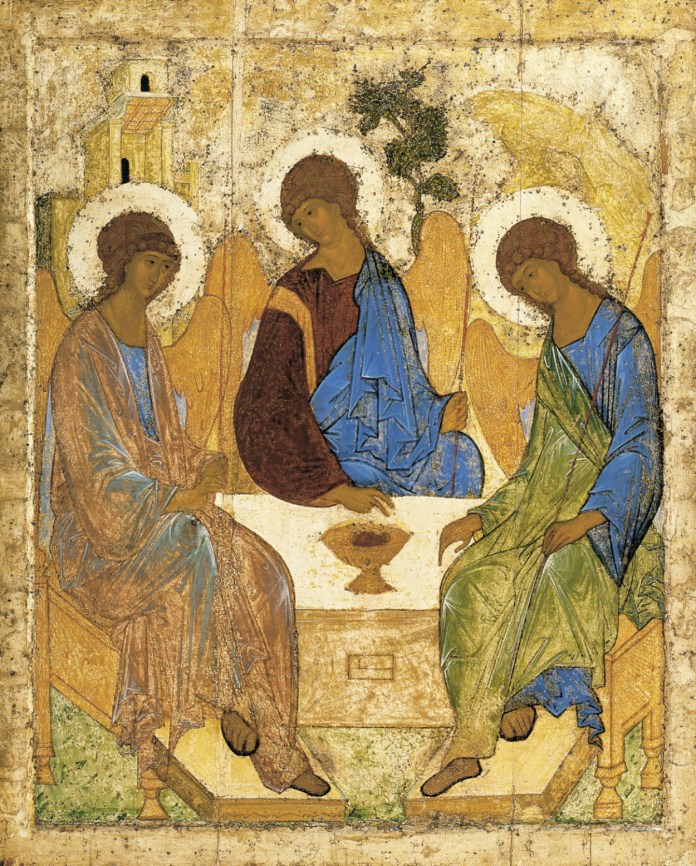
Andrei Rublev, “The Trinity”, ca. 1411


“Now faith is the substance of things hoped for…”

—Hebrews 11:1


Out on Interstate 80 in New Jersey, about 70 miles from Manhattan, is a little amusement park for young children. It’s called The Land of Make Believe. And it is located in the small town of Hope.

I’ve never been to the park before, although I’ve traveled through Hope many times.

Those 70 miles got me thinking:

Without a belief in Heaven, Hell loses it’s significance.

And a life without hope makes Hell very real.

———

Jesus came to make our lives joyful and full of purpose.

After all, He told us that “the kingdom of God is within”, and that “the kingdom of heaven is at hand”.

From such eternal optimism, which is most certainly and profoundly true, I can see how a temptation may arise. The temptation of thinking—of thinking there’s no other world than the current one we find before us, and that all we need to do is make this world a utopia via the right cultural, political, and economic policies. That it is all a matter of social justice.

Yes, it can be pretty tempting to turn the promise and proximity of Heaven into a man-made agenda. To begin to think that we can create “Heaven” here on Earth, and in the process convince ourselves and all around us, especially those “below” us, that there’s no Heaven or Hell beyond or beneath this current, known, and visible existence.

That of course also eliminates any Godly judgment to come. Which of course is quite convenient, especially when it comes to behavior that God’s Word and Jesus’ Church clearly declares sinful.

But I guess that’s just the point. Many of us want to live in The Land of Make Believe. Pretending. Perverting hope. And via this ongoing state of pretense and presumption, we wish to live in our own self-perceived, self-conceived, and self-serving Heavens, right here and right now, and only here and now—with no “other world” or consequences to come—and this makes many of us feel awfully good, at least for the time being.

Jesus teaches otherwise. For He also told us, through His dialogue with Pilate, that He came into the world “to testify to the truth”, and that His “Kingdom is not of this world”. And perhaps most convincing (and incredibly consoling as well) is what He reveals to the apostles the night before He suffers, dies, and is buried—in order to be resurrected—and eventually ascend into Heaven—to sit at the right hand of “God, the Father almighty, Creator of heaven and earth”:

“Do not let your hearts be troubled. You have faith in God; have faith also in me. In my Father’s house there are many dwelling places. If there were not, would I have told you that I am going to prepare a place for you? And if I go and prepare a place for you, I will come back again and take you to myself, so that where I am you also may be. Where I am going you know the way.”

John 14:1-4

We could list many more teachings of Christ that reiterate the same point. The totality, the oneness, of Sacred Scripture makes it abundantly clear that there is an eternal existence to come, that presently we are mere pilgrims just passing though, and that we are not destined to remain in this world. And Jesus also makes it abundantly clear that where He, the head went, the body too shall go—passing through the same cross-shaped gate.

Jesus came to show us how to love, and how to enter the Kingdom, both the Kingdom at hand and the Kingdom to come; one and the same but not limited to either one or the other. Heaven is here and continues thereafter, eternally. The “Alpha and the Omega, the First and the Last, the Beginning and the End”. For He, Jesus the Christ, the Word, the Lord God, “the one who is and who was and who is to come, the almighty” was with the Father before the world began…and He is also the one who “will come again in glory to judge the living and the dead” and whose “kingdom will have no end”.

It is all too much—and like the Trinity itself, and the Incarnation, and the Resurrection— Life Everlasting is beyond our comprehension. We simply can’t understand. It’s a mystery, but not a mystery that should lead us into the belief that this current world, this world of time, of pomp and circumstance, is the only reality, now or to come.

No, to be a Christian is to believe in Heaven, and Hell. And it is also to believe that through the death and resurrection of our Lord and God, our Savior and Redeemer, we can gain entrance to the eternal banquet, the everlasting feast, the never-ending day of love, of joy, of peace. The permanent Land of Belief.

And yet, in some not-so-mysterious way it begins right here on earth, in a very concrete manner, one smile at a time, one teardrop at a time. It begins when we truly believe in Jesus, follow Him and live the way He taught us. Just as does Hell, in some not-so-mysterious way, begin here on earth when we don’t truly believe in Jesus, follow Him and live the way He taught us.

It’s all kind of like The Land of Make Believe, that small amusement park off Interstate 80, out in western New Jersey. It isn’t real, yet it exists. It brings to life many more smiles than most regular, humdrum, midterm school days. And it has a beginning and an end—yet to children created in the image of God, it seems to go on forever…and in some grace-filled way, they’re exactly right.

You just gotta believe.

The Land of Make Believe is more than you ever dreamed it could be.

Oh yeah, and it resides in a place named Hope.


With tears flowing, the child’s father at once cried out, “I do believe! Help my unbelief!”

—Mark 9:24


(June/2016)
 

Standard
philosophy

School of Athens

by Howard Hain

raphael-school-of-athens-vatican-museum

Raphael, “School of Athens”, 1509-11, Vatican Museums, Raphael’s Rooms, Rome of the Segnatura


I see you there

Somewhere near the back

Hiding

Thinking no one can see

A priest

A prophet

A king to be

———

Socrates?

A profile

Like the head on a coin

Another good man

Snubbed for what he knows

Can’t see your face

Not fully

Say the least

Though perhaps

We too would die

A drop of hemlock

Is hard to swallow

———

Like that fine-feathered friend

All philosophers are

Little birds

Not too fat to fly

Aerial feeders

Circumventing the globe

Following truth

Wherever it go

———

Plato?

Yes

Now you

We see for sure

After all

Like a son

You and Socrates

Your father figure

Setting up shop

Hanging out

A common shingle

Hard to distinguish

In fact

The fiction

Son from Pop

One generation

Stumbles upon truth

The next

All about father’s business

Selling sovereignty

The sovereignty of Good

Not by peddling answers

By asking simple questions

———

Aristotle?

Yes

He made the frame

The third person

The younger brother of sorts

In some sense

Stealing the show

A third amigo

A sort of philosophic trinity

Aristotle the great

Teaching emperors to be

A bright bronze star

Mentioned last

Never least

A meta-physician

Looking not to the past

He expanded business

Once Plato left the scene

Pointing the way

He thought it should go

Down to earth

Keep it real

Hover low

Eyes on substance

On the truth below

———

Quite a team

These three musketeers

Sharp whiskers

Well-trained tongues

Doubled-edged swords

Wielded about

In universal hands

Yet many others

Names we might know

The great wall of knowledge

An army

To remain

The great unknown

———

Truth

Beauty

The noble pursuit

Lady Wisdom

Her many lovers

And each takes her as his own

A cloud of witnesses

Testifying one truth

The Communion of Saints

Under a different kind of roof

———

Look at that structure

Who built the arch?

It overrides

Every branch of the tree

If colored

It’d be a rainbow

Yes

That once great sign

Now brought so low

Meant so much

Primary color

Fragmented light

Quite a choice

Magic marker

Cross the sky

God’s endless love of life

A sacrament

One might say

A sign

As natural as natural can be

The offspring of union

A pledge

A covenant

A promise

The kind that brings new life

Adam

Then Eve

Woman created

From the lonely side of man

To lovers

Of such wisdom

Truth is clear

The rainbow redeemed

It will once more

Point to the sun

After yet another storm

The fullness of noon

Its rightful place

Where nothing disordered

Continues to loom

———

Welcome home

Child of wonder

Come on in

The water’s warm

Jump high

Up over the frame

Roman columns

Marble floor

Robes in many shades

Your heart

Away from home

Bring nothing more

Leave your sandals

At the door

A burning bush

Holy ground

Children at play

A clubhouse of truth

Safe and sound

Slides and swings

Monkey bars

Hang on tight

Hold on loose

No possessions

Got to share

Acts

Appreciation

Sons of liberty

Daughters of revolution

The mulberry tree

What’s that?

Your degree?

Of such things

We just don’t care

———

Poetry

Completely still

Motion

In dialogue

Statues

Alive

Silent features

Arch

And texture

Every detail

All one view

Did you hear?

Have you seen?

The latest

No not the news

What’s truly new

Not the fleeting

Nor the slice

Not cutting edge

What’s new is old

All under the sun

Originality

Yesterday

Genesis just begun

Just a few rules

Keep perspective

A frame

If you will

A type of kind

Boundless

Creativity

Yes

But not for sale

Bring what’s prized

Not the least

Only one item

The book of life

———

God became man

Truly human

Not veneer

Truth among us

Not to abolish

Bring to fullness

Humanistic pursuit

The glory of God

Made manifest

In man’s pursuit

Of God Himself

———

Jesus

In disguise

The philosopher’s cloak

Reaching upward

To shake His own hand

At the right side

God the Father


raphael-school-of-athens-1509-1511

Raphael, “School of Athens”, 1509-11, Vatican Museums, Raphael’s Rooms, Room of the Segnatura


Web Link: Vatican Museums, Raphael’s Rooms, Room of the Segnatura


(June/2017)


Standard
philosophy

Other People Breathing


The beautiful sound of other people breathing.

Community.

The bedroom: His wife. His child.

The chapel: The old man. The widowed woman.

The bus: Tired husbands. Lonely brides.

The playground: Pants. Screams. Screeches. Cries.

The everywhere: Fear.

Suffering has a sound.

Heard like a rattle.

Beads dropping one by one.

A xylophone. A harpsichord. A tambourine.

A one-man-band.

In union a sweet ave.

Isolated a crashing cymbal.


—Howard Hain


(May/2018)


Standard
philosophy

Two Little Flowers


DT1398

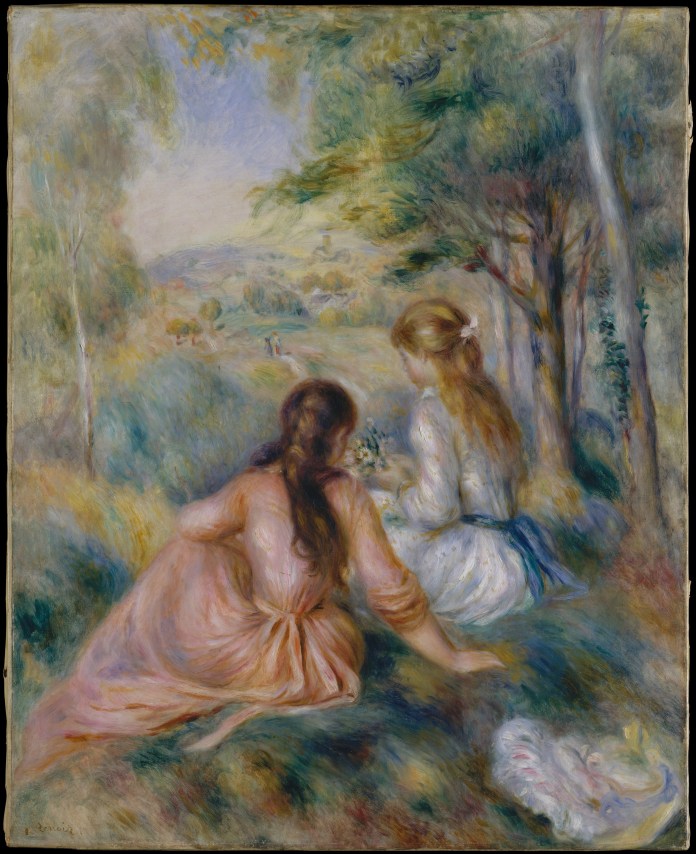
Auguste Renoir, “In the Meadow” (1888-92) The Met 


Two Little Flowers

Side By Side

Stretching Toward The Sun

Slightly Different Shaped Petals

Slightly Different Shades Of Pink And Blue

Sing And Dance

Dance And Sing

Waving Hello

Smiling Goodbye

Two Little Flowers

Side By Side

Stretching Toward The Sun


—Howard Hain


Web Link: Auguste Renoir, “In the Meadow” (1888-1892) The Met


(May/2018)


Standard
philosophy

A Good Cry

by Howard Hain

walter_langley_-_never_morning_wore_to_evening_but-some-heart-did-break-1894

Walter Langley, “Never Morning Wore to Evening but Some Heart Did Break”, 1894


Rejoice with those who rejoice, weep with those who weep.

—Romans 12:15


Sobbing is quite an amazing act. When someone really let’s go. The back shakes, the stomach heaves, giant tears rain down. The sound is unlike any other. The cry of the truly poor. The wailing. The bursting forth of what no longer can remain contained. The release. The death. The life.

With a loud cry Jesus died.

God…something to truly behold.

The man. The woman. Rachel refusing to be consoled.

And then it stops. Like a torrential downpour that just can’t last that long. The hard, fast, terrible roar of a summer thunderstorm. It comes and goes. The floods flash, then creation smiles once more—it almost winks, as if nothing ever happened at all. Brother Sun reappears. The black clouds scurry into the distance. Streams of light, sunbeams, tunnel through whitewashed clouds. Sister Moon prepares a crystal clear night.

And Jesus wept.”

I imagine that Jesus also laughed.

Perhaps as a child He even giggled.

Yes, I like to think of Jesus as a small boy. A funny, kind, sweet, happy child. Yes, I imagine He liked to laugh. Yes, I can see that. Imagine it, right? Little Jesus and Mary laughing, Joseph laughing too—maybe even lovingly shaking his head a little as he walks past the two of them on his way back to the shop—enjoying the sight of his bride and boy bathing the monotony of domestic life in tender moments of lightness such as these.

Yes, I imagine that they even had those small humorous encounters that only the inner members of an intimate, tightly-knit family can engage. Those little looks and quiet soundless chuckles that release the tension of living in too-close quarters, among people you love so much that the temptation arises of becoming annoyed at even their genuine goodness.

Perhaps though I am biased. For some of my fondest memories as a child are of being together in the same room, the six of us: four boys, and Mom and Dad. And what was best of all was the laughing, especially the uncontrolled laughter of children engaged in outright silliness, the kind that Mom and Dad—even though they we’re saying “come on, stop it now”—they themselves couldn’t help cracking smiles. Sometimes those fits of laughter were self-induced or at least group-induced, via my elder brothers tickling us nearly to death.

For there is a type of laughter that can only be laughed by a child. And as I am sure most of us can recall, the second those tickling sessions began we’d beg for mercy for it to end. And the second it was over we would ask for more.

Uncontrollable sobbing.

Uncontrollable laughter.

They are quite similar. In fact, they sometimes occur simultaneously. And often when they continue past a certain point, the person begins to cough. I guess, physiologically, it’s caused by some kind of gasping for air that both prolonged sobbing and deep laughter call for, but it is a whole lot more.

It is a purging, a clearing out. As if the crying and laughing chip loose and shake free those emotional “buildups” lodged in our souls, plastered to the inner walls of our spirits.

And whether we are brought to our knees by bouts of bitter wailing or fits of uncontrolled laughter, or both, something remains after they go, like the pavement after those quick, fierce summer storms on brutally hot days. For whether those storms rain on our parades or provide our flowers with a desperately needed drink, it’s always a beautifully peaceful sight to see the hot ground, sidewalks, and driveways slightly smoking—a haze of mist signaling that a deeply hidden storm, a raging fire deep below, has met its match.

We dry off, and begin again.


(May/2016)


Standard
philosophy

Being qua Being


Learn from the way the wild flowers grow.

—Matthew 6:28


Does a flower make pronouncements? Does it define itself? Does it box itself in with titles, names, and distinctions?

And yet, “not even Solomon in all his splendor was clothed like one of these.” (Matthew 6:29)

———

A flower simply exists.

And its existence glorifies God.

There is no need for it to do more.

By its very existence it magnifies what cannot be further magnified: God’s Presence, God’s Glory, God’s Beauty…

———

“I’m a flower.”

“I’m a rose.”

“Look at me!”

Statements such as these we shall never hear.

Flowers are divinely indifferent to the world’s definitions and distinctions, to its approval and applause.

After all, it’s a person who receives the medal at an orchid show, not the flower herself. No, her finely-placed petals would only be weighed down by such metallic-based ribbons.

What a gift it is to simply exist.

———

Flowers don’t cling to seasonal life.

When it’s time to go, they gracefully drop their heads and lose their petals.

Never has there existed a man as poor as a flower.

Never has mankind so possessed the richness of fleeting, transitory, and momentary life.

It’s their genius to instinctively believe that death leads to new abundant life.

———

Flowers graciously receive:

Ladybugs, drops of dew. Beams of light, the relief of shade.

Flowers give and receive as if not a single thing has ever been made by man.

They welcome sun as well as rain.

They never cry over fallen fruit or a stolen piece of pollen.

They quietly applaud instead, rejoicing that their little ones have the opportunity to travel abroad—perhaps even the chance to help nurture a neighbor.

———

A flower, perhaps most of all, knows it place.

It never wishes to be bigger or thinner…greener or higher…it never dreams of being more like a tree.

A flower’s blessing is simplicity beyond you and me.

———

Christ is a flower.

He is the one true perfect eternal flower, through whom all other flowers partake, toward whom all other flowers reach.

Christ is a flower. His ways are not our own. He simply exists. Bowing His head. Dropping petals. Feeding hungry bees. Giving and receiving. His identity is crucified—leaving nothing behind but being “qua” being.


If God so clothes the grass of the field, which grows today and is thrown into the oven tomorrow, will he not much more provide for you, O you of little faith?

—Matthew 6:30


—Howard Hain

(Dedicated to Brother Jim, a man who knew how to simply exist.)

(July/2016)


Standard
philosophy

A Bouquet of Marys


pierre-auguste-still-life-of-roses-in-a-vase-1910-19-renoir

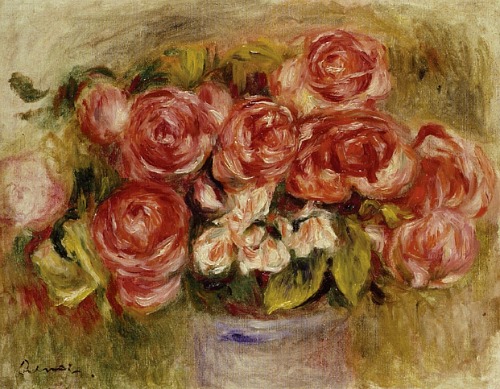
Pierre-Auguste Renoir, “Still Life with Roses in a Vase”, 1910-19


Fount of Life

Fire of Love

Sweet Anointing From Above

Come Holy Spirit!

Come Holy Spirit, living in Mary!

———

A simple thought. At times that seem complex:

If every Mary in my life is praying for me, then all will turn out well.

I find that some of the most challenging times are times of serious discernment, when decisions have to be made—not made-up manufactured dilemmas, the conjectures of our overactive and self-obsessive minds endlessly playing shell games with hypothetical possibilities—but substantial concrete decisions, those times of choosing one real and reasonable path as opposed to another, equally real and equally reasonable.

These times can be quite unsettling, even if both paths are seemingly sunny. For if we desire to do God’s will and attempt to put aside our personal preferences, quite often the “right” choice is not crystal clear.

We use our minds, we use our experience, we research the facts, we reach out to trusted spiritually-solid Christian brothers and sisters for opinions and guidance, but ultimately it is not a simple matter of calculation. It is not a matter of which option has more pros and less cons, of which path offers more or less in terms of provision, obstacles, enjoyment, sacrifices, etc. Sure those things should be taken into consideration, thrown into the pot if you will, and stirred well—on low heat for that matter, and over a good amount of time.

But it is all about God’s will, and God’s will may defy logic, especially the logic of lists.

So what is left but prayer, prayer and waiting for the peace that should accompany sound, Holy Spirit-led decisions?

So we stir the pot, we pray, and we wait. We take a sip and see if it settles peacefully into the stomach. And we stir some more…

But sometimes, the time for the decision to be made comes before we feel properly prepared—or in dinner-party terms, the guests are at the front door and we feel that the soup hasn’t yet properly stewed.

It’s times such as these that we need our mothers.

I gather up my list. No, not the pros and cons, but one of the most important lists that I can assemble: the list of Marys in my life. I think about the women God has placed all about me: my earthly mother, my wife, my mother-in-law, a nun I know well, my sister-in-law, my landlady, a woman I see regularly at the bakery, several ladies from my parish who gather faithfully for Mass and to recite the Rosary.

These are my Marys. I gather them together: I ask our Blessed Mother, as guided by the Holy Spirit—her heavenly spouse—to unite them to her and with her in prayer. I then ask each one of them. One by one, as I see them or speak to them by phone. And I ask. I ask simply that they pray for me, that I do God’s will.

Then I rest assured. I sit back. I smell something delicious. But it’s not the soup. No, what my nose savours is the scent of a beautiful bouquet. My bouquet of Marys.

No matter what happens from here on out—I know I come out smelling like roses.

———

Hail Mary, all my Marys

Full of Grace

The Lord is with thee, all of thee

Blessed art thou amongst women

And blessed is the fruit

Of thy womb, Jesus!

O Holy Marys, pray for us sinners…now…and at the hour of our death.

Amen.

———

Dedicated to all the Marys in all our lives, during this “Magnificat” month of May, a month full of days filled with grace.

Happy Mother’s Day!


—Howard Hain


(May/2016)

Standard
philosophy

Joseph the Worker


jean-franc3a7ois-raffac3ablli

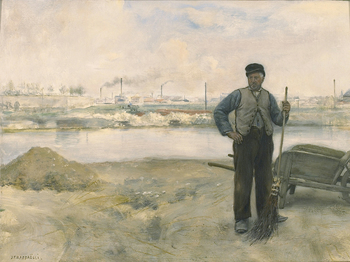
Jean-Francois Raffaelli, “The Sweeper” (circa 1879)


there are not many choices

really there are only two to be exact

to suffer in union with Christ, or not

for to suffer not is not a choice

at least not while we are passing through

so we lift up our tired eyes

we strain our necks elevating our chins

we become like David

we strum our harps

for kings are not the only ones who sing sad psalms

David is not the only musician of pain

for just this morning I saw several on their way to work

one drove a van, another a box truck, a third carried a broom

each had a song, each strummed along

each is of the house of David, each a spouse of Mary

which ones however, if any, offered up the pain

that I do not know

only our Father above knows who it is that unites his suffering to Christ’s

only the silent Christ in each one of us could make such a noble choice

———

—yet another man named Joseph, a son of David


(Howard Hain)


(March/2016)

Standard
philosophy

Building Strength

by Howard Hain

jacopo-tintoretto-the-ascent-to-calvary-1566-67detail

Jacopo Tintoretto, “The Ascent to Calvary”, 1566-67 (detail)


In spiritual matters, weight training principles often apply:

Without sufficient resistance, strength won’t increase.

Resistance is then not only something to be tolerated, it’s to be seen as necessary, as something desirable:

Without proper resistance, real growth won’t take place.

In fact, the more resistance the better, as long as we maintain good positioning and form, eat and drink properly, and get enough off-time and rest.

In spiritual terms, these conditions easily translate:  1) Stay close to the Holy Sacrifice of the Mass and receive the Body and Blood of Christ with a grateful heart; 2) Remain in the Word of God and actively do the will of the Father; 3) Live a life of mental prayer—residing continually in “your inner room”—where we encounter the Divine Presence and lovingly adore the One True Source of all existence.

Let us then not be fools and seek shortcuts. Let us put aside all fads and worldly ways. Let us instead properly train, keeping in sight, and practice, the very basics:

To build strength, we need resistance.

Accept resistance then in every form—obstacles, roadblocks, annoyances, ridicule, mockery, difficulties, delays…

Accept it all as if directly delivered to you from the personal-training hand of God.

Accept it willingly, thankfully, even joyfully, as if weight added to the bar—as part of perfectly planned resistance—individually and specifically designed to increase moral strength and spiritual stature.


(April/2017)


Standard